Sotheby's: Important Events as the year ends.
- by Announcement, Rare Book Hub staff
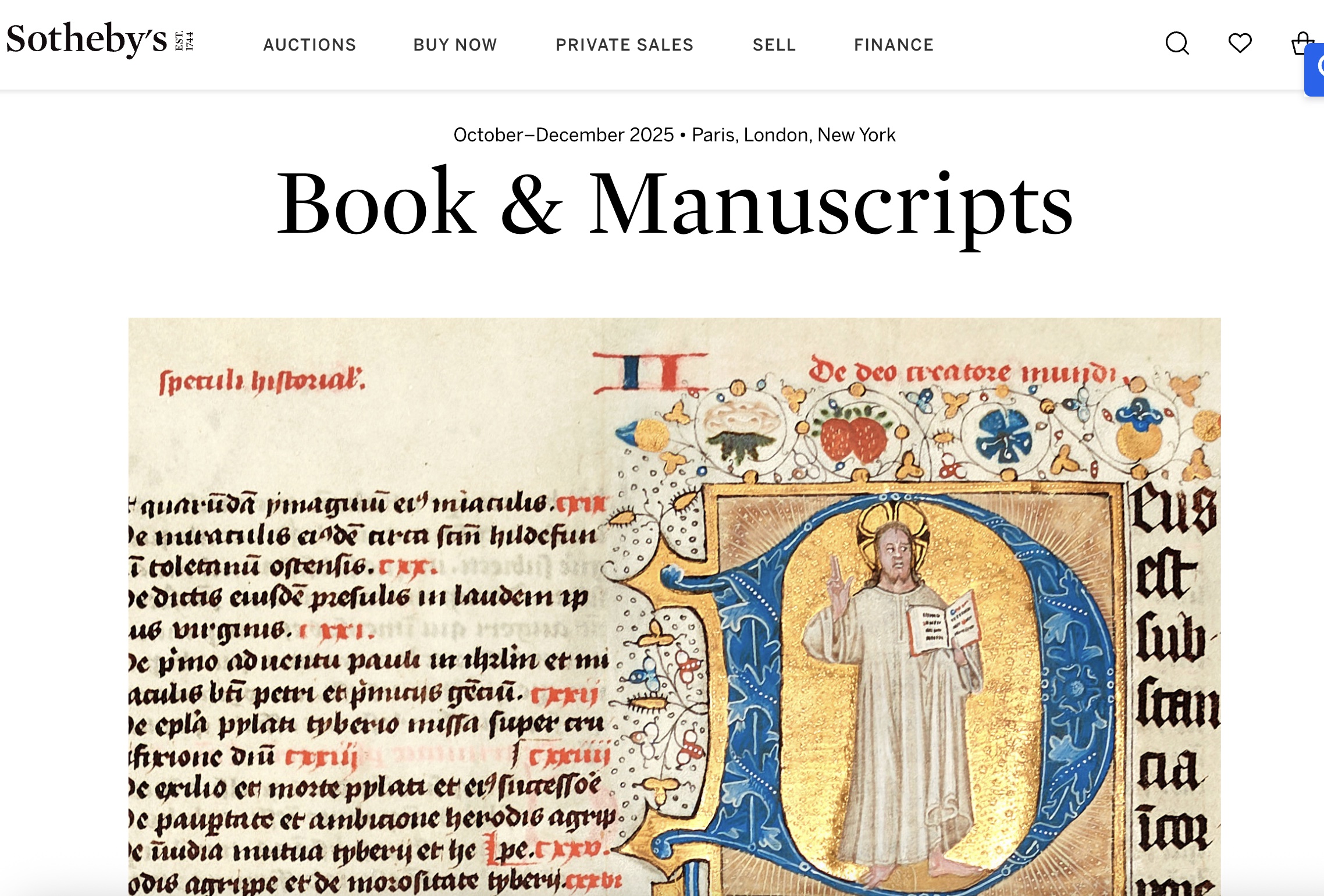
Important Events as the year ends
Amidst a very busy December schedule for Sotheby’s global Books and Manuscripts Department, “The Library of Bary Yampol: A First Selection” stands out as the highlight of the month. Barry Yampol (1937–2023) was known worldwide as a collector and dealer of mineral specimens and gemstones, a passion that benefitted from his great success in the telecommunications business. Many institutions, including the Smithsonian Institute, the Yale Peabody Museum, and the Sorbonne, benefitted from loans from Yampol’s collection and other support he provided.
Much less well known was Barry Yampol’s concurrent book collecting. While he was the most public of figures in the world of mineral collecting, in the republic of books Yampol strove, successfully, to maintain his anonymity. Still, he became one of the most discriminating collectors of the last half century of books illustrating the history of science. While mineralogy and mining are certainly prominent in the Yampol Library, they are far from the only focus.
Expected authors will be found in the first auction—Agricola, Albertus Magnus, Gautier D’Agoty, Kircher, Sowerby, and William Smith, among others—but so will some surprises, including the Doheny copy of Aristotle’s Opera in Greek, printed by Aldus, 1495–1498; the 1482 Euclid printed by Ratdolt from the Norman collection; two of the most important incunable editions of Pliny; a complete set of Diderot and D’Alembert’s Encyclopédie; Hooke’s Micrographia, 1665; the Botfield copy of Sir William Hamilton’s spectacular Campi Phlegræi, 1776–1779; and Mendeleev’s Principles of Chemistry, in Russian, 1869–1871.
The First Selection from the Yampol Library (at least one more will follow in 2026) is itself divided into two parts, as has become customary for major auctions at Sotheby’s New York. On December 9, 3:00 pm, twenty-four of the most valuable books from the first selection will be offered in Part 1, a live sale at Sotheby’s new global headquarters at 945 Madison Avenue in the iconic Breuer building, former home of the Whitney Museum. The Yampol Library will be the maiden book auction in the new building. The balance of the books in the First Selection will be sold online in Part 2, open for bidding now and closing starting at 2:00 pm on December 12.
Part 1 includes what Selby Kiffer, Sotheby’s Senior International Specialist for Books and Manuscripts calls “some of the best copies of truly significant books that I have handled in many years.” A few of these “truly significant” works are the fine Countess Doheny set of Aldo's editio princeps of Aristotle (Venice, 1495–1498), as well as the other ancient texts included by Theophrastus, Porphyry, and others ($400,000–600,000). The Aldine Aristotle was, in terms of scholarly enterprise and vision, the greatest printing project of its century: the complete Opera represented more leaves of Greek type than had cumulatively been printed since the time of Gutenberg. The Aristotle was a conspicuous lacuna in the Aldine portion of Bibliotheca Brookeriana, sold by Sotheby’s, October 2023–June 2025.
Other early printing includes a remarkable Sammelband of pseudo-Aristotle and Isidorus Hispalensis that features the first printed lapidary, Merseburg, 1473; and the first printed map, Augsburg, 1472 ($150,000–250,000). The very rare Lapidarius falsely ascribed to Aristotle is the second book printed in Merseburg; the Yampol copy is one of just ten surviving copies, and the only other copy in the United States is at the Huntington Library. The first edition of Isidore’s encyclopedic Etymologiae of Isidore of Seville, Günther Zainer's first book printed in Roman type.
Two highly significant incunable editions of Pliny’s Natural History are also featured. The Macclesfield copy of Historia naturalis, printed in Rome, 1470, by Conrad Sweynheym and Arnold Pannartz is arguably the most spectacular and intriguing book in the First Selection from the Barry Yampol Library ($900,000–1,200,000). The second edition of Pliny—but the first from a rigorously edited authoritative text—this is one of three copies printed on vellum, rubricated throughout and with gilt Roman white vine-work initials. The Macclesfield copy contains twenty-five leaves in exactly contemporary manuscript, including leaves 1–5 of gathering 23—however, in quire 23, fos. 6–10 are printed. Thus, quire 23 is unlike anything known elsewhere: it has five sheets, and the first half of all five were unprinted, while the second half were printed. This is essentially incontrovertible proof that the manuscript leaves were supplied in the Sweynheym and Pannartz shop.
The second fifteenth-century edition of Pliny offered in Part 1—three further incunable editions are in Part 2, as well as the important 1539 Froben printing with commentary by Sigismund Gelen—is the first edition in Italian, translated by Cristoforo Landino, printed in Venice is 1476 by Nicolas Jenson, from the library of Otto Schäfer ($300,000–500,000). This Pliny is the most significant and best documented publication from the presses of Nicolas Jenson, and the Yampol copy is bound in elaborately blind-tooled contemporary Florentine calf, with fine illumination attributed to Francesco d’Antonio del Chierico. The full online catalogue for Part 1 is here: The Library of Barry Yampol: A First Selection. Part 1.
The online portion of the Yampol auction (catalogue here: The Library of Barry Yampol: A First Selection. Part 2) is of similar nature and even more eclectic. In addition to Pliny, authors who appear in both parts include Agricola, Albertus Magnus, Euclid, and Hooke; similarly, both parts are rich in works on minerals and mining, geology, chemistry, and Wunderkammer, but Part 2 also covers medicine (Paracelsus, Chirurgische Bucher und Schriffeen, 1605; the Honeyman copy; $10,000–15,000); meteorology (Almedigen and Ludwig’s Pyrotechnia sublimis saeculi primaeui, 1778; $1,200–1,800); fossils and paleontology (Conrad Gesner’s De omni rerum fossilium genere, 1565; $2,000–3,000); travel (Engelbert Kaempfer’s De Beschryving van Japan, 1733; $3,000–5,000); physics (Max von Laue’s “Eine quantitative Prüfung der theorie für die Interfencz-Erscheinungen bei Röntgenstrahlen,” 1912; $10,000–15,000); distillation (Giovanni Battista della Porta’s De distillatione lib. IX, 1608; $4,000–6,000), and a myriad of other branches of science and their practical applications.
Barry Yampol collected in depth, and several authors in addition to Pliny are represented by at least three titles or editions: Vannoccio Biringucci, Herman Boerhaave, Athanasius Kircher, Martin Frobenius Ledermüller, Johann Jakob Scheuchzer, Jean Baptiste Tavernier, and Abraham Gottlob Werner. One reason to pay close attention to the Part 2 sale is that all lots with a low estimate of $2,000 or less are being sold without reserve.
But as mentioned at the outset, the sale of the Barry Yampol is not Sotheby’s only book and manuscript sale in December, or even the only one in New York. The month begins with a selection of atlases and works of travel and exploration featured in a live, multi-department auction in London on December 2, “A Worldwide Grand Tour: The Sven A. Behrendt Collection.” Also in London, online, and currently open for bidding through December 9 is “Western Illuminated Manuscripts,” featuring a magnificent illuminated portolan chart of the Mediterranean world, signed and dated by Petrus Roselli, 1447 (£700,000–1,000,000). This beautiful portolan chart is the earliest of ten navigation maps signed by, or attributed to, Petrus Roselli, the most prolific member of the Mallorcan cartographic school. London additionally has a general sale of “Books, Manuscripts & Music” online, open now and closing on December 11.
New York also has a general online sale of “Fine Books and Manuscripts, including Americana,” closing on December 16. Of particular interest there is the unique surviving copy of “The Freedman's Primer” an 1864 primer specifically designed for the use of formerly enslaved persons ($25,000–50,000). The following day, December 17, Sotheby’s closes its sale of “Important Judaica,” including books and manuscripts; the online sale opens for bidding on December 3.
Finally, after four auctions in New York and three auctions in London, Bibliotheca Brookeriana moves to Paris, where bidders will have a second opportunity to bid on lots that were unsold the first time around. Estimates have been revised and a number of lots are being offered without reserve. The online sale opens for bidding on December 3 and closes on December 17.
Details, including full online catalogues, on all of these and other Sotheby’s book and manuscript sales can be found on the calendar page of the Sotheby’s website: https://www.sothebys.com/en/calendar?locale=en.