Gertrude Stein, Houdini & Gutenberg Bible exhibits at Ransom Center, UT Austin
- by Susan Halas
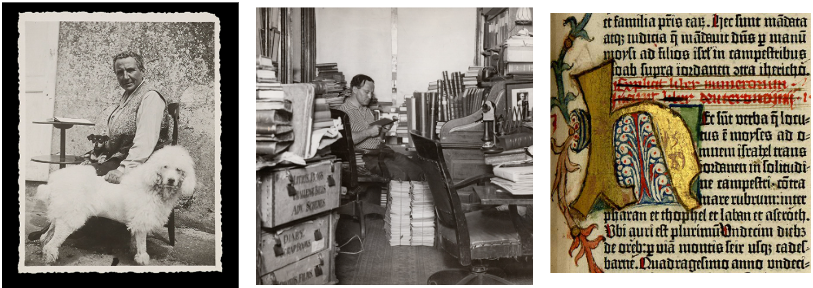
The Harry Ransom Center at the University of Texas - Austin feature exhibits in September including Gertrude Stein, Harry Houdini and the Gutenberg Bible.
Three eclectic exhibits are now on view at the Harry Ransom Center (HRC) at the University of Texas in Austin. The shows featuring the world of Gertrude Stein, the library of Harry Houdini and the Gutenberg Bible can be seen live at the center’s galleries and also have photos and digital material available online.
The Worlds of Gertrude Stein through Jan. 11, 2027
Organized by guest curator Dr. Sophie Oliver, a Senior Lecturer in Modernism at the University of Liverpool, this exhibit runs through Jan. 11, 2027. Clothing, stationery and household items tell a story of Stein’s life in Paris with Alice B.Toklas, their ideas about taste and beauty and their attempt to shape Stein’s literary reputation. Stein was an openly gay woman and shared her life for over 40 years with partner Toklas.
The exhibit illustrates Stein’s role in avant-garde art, while manuscripts and books document her radical experiments with language. See a variety of photos from the installation at https://www.instagram.com/p/DcReH-goyYy/?img_index=10
In a recent interview with the Daily Texan curator Oliver commented, “One of the worlds of the exhibition is her home, the home she shared with lifelong partner Toklas.” According to Oliver “Toklas is really the key to Stein’s writing life because she provided this sense of domestic stability, she made it possible for Stein to write.
“I hope that people who don’t know her work can get to know a little bit about it, without feeling daunted. … One thing that’s always said about (the works of) Gertrude Stein is that it’s difficult, that it’s hard to understand. … What I tried to do was use these objects, these unusual things that are from her ordinary life, to ground this difficult work in the ordinary dailiness of her existence and show that despite the complexities of her writing, she, like all of us, lived an ordinary life; ate, drank, cooked, lived with her partner, who made her clothes, and all these things informed her writing.
“So what I hope is that these ordinary and intimate aspects of her daily life are a way into a radical experimental writer, and I hope they appreciate the range of her, the complexity of her work and as a person… Stein’s philosophy and her work were all about slowing down to think about how we’re feeling, how we’re perceiving, and seeing those things anew, never accepting things as they are, always wanting to inject things with a sense of novelty of how things could be.”
A BBC Radio 3 episode featuring Oliver commenting on Stein’s home is available at
https://www.bbc.co.uk/programmes/m0026nml
Houdini’s Library through Jan. 24, 2027
An exhibition exploring the life and extraordinary collection of Harry Houdini, one of history’s most famous illusionists, is on view at the Ransom Center through January 24, 2027.
On stage, Houdini crafted his performances with a deep sense of history often referencing the magicians who came before him. Off stage, he spent years building a collection of books, manuscripts, and ephemera documenting the long global history of magic and theatre.
From a first edition of Reginald Scot’s 1584 classic The Discoverie of Witchcraft to the handwritten travel diary of legendary actor David Garrick, they reveal how Houdini’s collection sought to preserve history—a tradition continued by the Ransom Center since it acquired his collection in 1958. This presentation commemorates the centenary of Houdini’s death in 1926.
The show is curated by Dr. Eric Colleary, the Cline Curator of Theatre and Performing Arts at HRC. A video about Houdini’s Library by Dr. Colleary goes live on Sept. 27 at https://www.youtube.com/watch?v=KGOl5Q_TjBY
He is also the author of a companion book of the same title to be published by the Abbeville Press in mid-September. It traces the growth of the legendary illusionist’s collections throughout his career and illustrates hundreds of his treasures—many for the first time. https://www.abbeville.com/products/houdinis-library
The Gutenberg Bible is on permanent display at HRC including a digitized version
Acquired in 1978, this Gutenberg Bible is always on view at the Harry Ransom Center. A digitized version of the HRC copy can be viewed at https://hrc.contentdm.oclc.org/digital/collection/p15878coll100/id/2664/rec/1
The Ransom Center's copy represents one of only 20 complete copies in the world that survive intact. Printed on paper, the two volumes remain in early bindings and feature text and decoration added by hand. In the first volume, books of the Bible begin with two types of distinctive, colorful letters. The second volume features more traditional red and blue initials.
In Mainz, Germany, in the mid-1450s, Johann Gutenberg and his partner Johann Fust published more than 150 large-format copies of the Bible in Latin. This is the book known today as the Gutenberg Bible. Gutenberg may have begun developing a new printing technology as early as the 1430s, and completion of the Bible demonstrated the viability of a press that used individual pieces of metal type to mass-produce books. Although books would continue to be written by hand in the years— and centuries—that followed, the printing process pioneered by his team became increasingly prevalent, helping change how information traveled in Europe and, later, the world.
Harry Ransom Center
University of Texas at Austin
300 W. 21st St.
Austin, TX 78712