A Half Million Dollar Study Will Examine a 400-year-old Book Made from Feathers
- by Michael Stillman
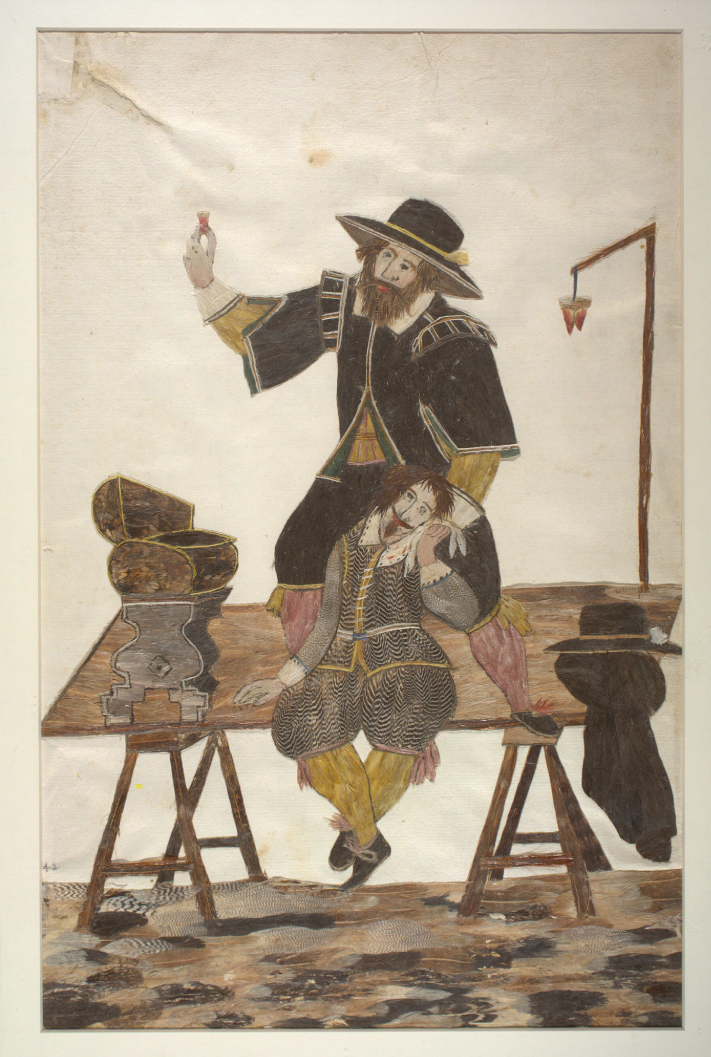
Pulling teeth in the 17th century.
An almost half a million dollar grant has been issued to study a single book. It is very old and very unusual. It reminds us of the Voynich manuscript, that strange, hand-written and illustrated 17th century book, written in a language unknown and indecipherable. This one is different. It is written in a real language, Italian. What is odd is that its illustrations are primarily composed of bird feathers. Most illustrations, logically, are of birds, but many others are of unrelated scenes. Unlike the Voynich manuscript, its author is known. It is Dionisio Minnaggio. What is not clear is why he did this. Considering it was made over 500 years ago, we can't ask him, so we will have to just wonder why.
The book is known as Libro di Piume, or the Feather Book. While composed mainly of feathers, it also uses other parts of birds' anatomy, such as skin, beaks and talons. Along with bird illustrations there are those of humans and various other scenes with humans or animals present. Only one is strictly a scene. An odd one shows a Medieval dentist displaying a tooth he has just pulled from a patient, the patient with a bloody cloth by his mouth. Others display people playing musical instruments, riding a horse, and one with a dog in the midst of pooping. Maybe Minnaggio should have stuck with bird portraits.
Minaggio was the chief gardener for the state of Milan. The book attributes its creation to the year 1618. We don't know a lot about its history. During the 18th century it was owned by Taylor White, an English judge. It was acquired by McGill University in 1923. It is currently held in their library.
The $479,890 grant will be used to study the book in great detail. Non-destructive scanning will enable a team of scientists, historians, librarians and curators from four countries to get an in depth look at the book and its avian parts. It will fund the book's restoration, exhibition, and an accompanying catalogue. The study is expected to take four years, only a drop in the bucket of time for a book over 400 years old.