One of the Largest, Heaviest, and Most Valuable Books Ever Made Has Been Stolen
- by Michael Stillman
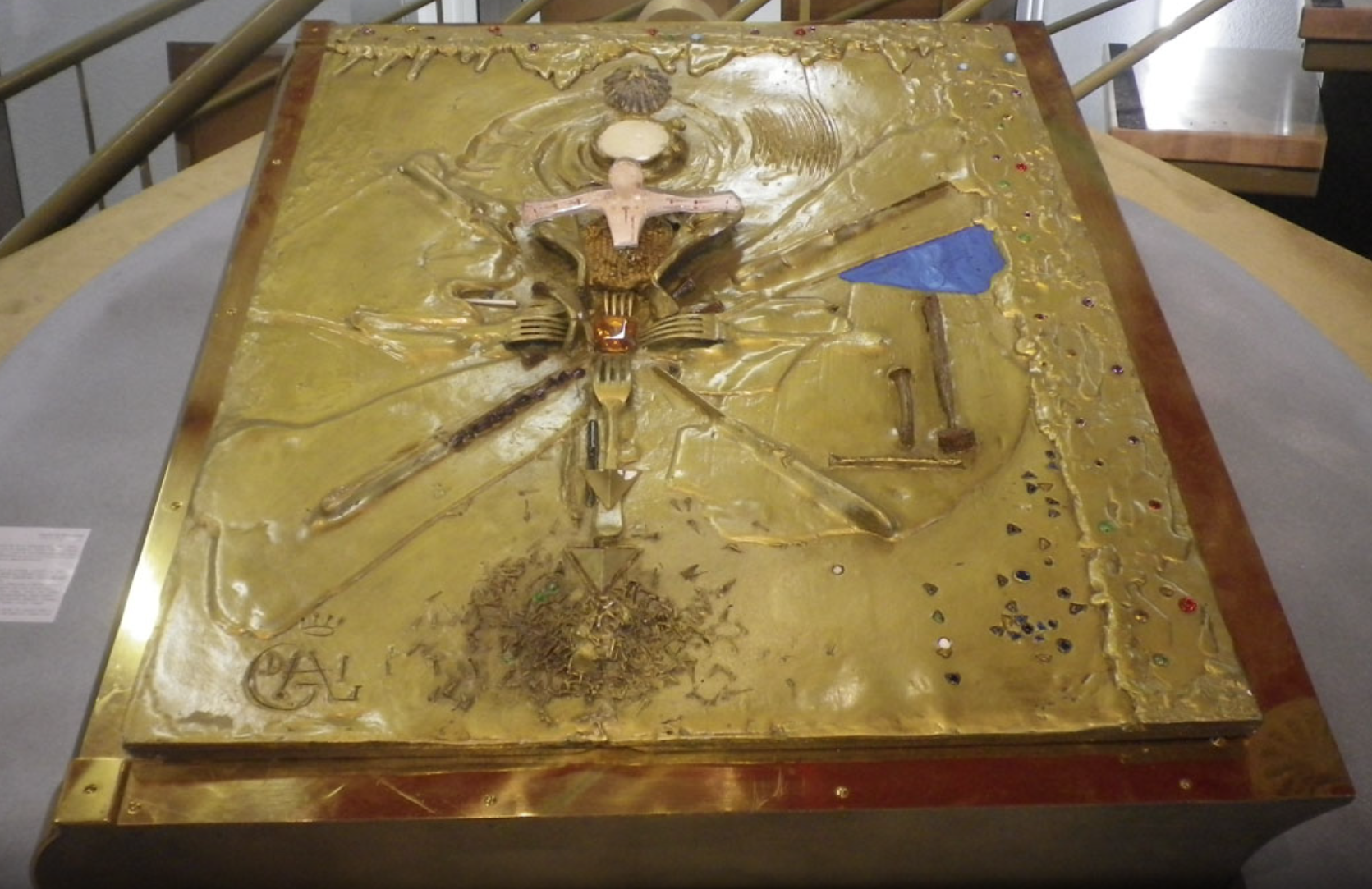
A facsimile created by Forêt at the Joseph Forêt Cultural Space at Mont-Dore.
Book theft is not a great rarity. One can readily slip a book under their coat and walk off with it. However, that was not the case with this book. It weighs 436 lbs. This takes more serious planning and physical strength. Nonetheless, such a theft took place on the night of October 4-5 from the C. Karoutzos Center for Contemporary Art in Issoudun, France. How the thieves (we must assume multiple) pulled this off is unclear, but they did it. The next morning, the gates to the building where it was housed were found to have been broken open and the plexiglass cover shattered.
The book is L'Apocalypse, better known as the Book of Revelation. Considering they needed 463 pounds of material for just the final book of the New Testament, it is understandable why they didn't do the entire bible. It is a one-of-a-kind, the only one made. It was a created by Joseph Forêt from 1958-1961. Forêt was a publisher, and though his overall work is not that notable, he will be remembered for this masterpiece, one of the greatest books ever made.
This book broke all kinds of records. At the time of its creation, it was described variously as the largest, heaviest, and most valuable book in the world. It was made from 150 parchments selected from 300,000 sheepskins. Forêt wanted the best. Two thousand hours of caligraphy were employed, with 550 gold letters.
Forêt couldn't have created this alone. He had help from some of the greatest artists and writers of the time, fourteen of them including Salvador Dali and Jean Cocteau. The illustrations were by Dalí, Bernard Buffet, Léonor Fini, Foujita, Trémois, Mathieu, and Zadkine. Meditations were provided from Cocteau, Rostand, Giono, Rops, Guitton, Cioran, and Jünger.
Yet, despite the original creations of these greats, it is not the words of the great writers' nor the illustrations of the great artists that makes this book so valuable. They are secondary to the value. The thieves didn't even want that part. They left it behind. If you think you can't judge a book by its cover, this one is the exception. It is the cover that makes it so valuable, and this is what the thieves were after. It was all they took. This is also why the authorities in French culture are so upset and scared by this particular theft.
This cover is spectacular. Even though the thieves took only the cover, it still weighed 330 pounds. The cover was made from bronze, explaining its great weight. But even that is the smaller part of its value. Dali designed the cover, and he placed many jewels on the cover. Therein lies the greatest part of its value. It is also why in France this is considered a major cultural work. For some, the cultural value is even more than the enormous monetary value.
On completion, Forêt took his book on tour. It appeared in 150 exhibitions in numerous countries from 1961-1972. It was then stored in Switzerland until sold to some Japanese collectors. They in turn sold it to Christian Karoutzos, the CEO of an art restoration company. He put it on display at the C. Karoutzos Center for Contemporary Art. That's where it stayed until the night of October 4-5.
Authorities have been puzzled over how the thieves pulled this off. It obviously required a lot of thought and planning. These were no amateur thieves. What has the cultural experts so upset and scared is the thought of what the thieves will do with the book. Obviously, you can't put it up for sale. The fear is they will pull the jewels out of the cover and sell them separately, and then melt down the bronze cover to sell the metal. If they do, this treasure of French culture, this magnificent creation of Forêt, Dali, and others, will be lost forever.