Custer, the Gold Rush, a Liver-Eater and More from Old West Books
- by Michael Stillman
Custer, the Gold Rush, a Liver-Eater and More from Old West Books
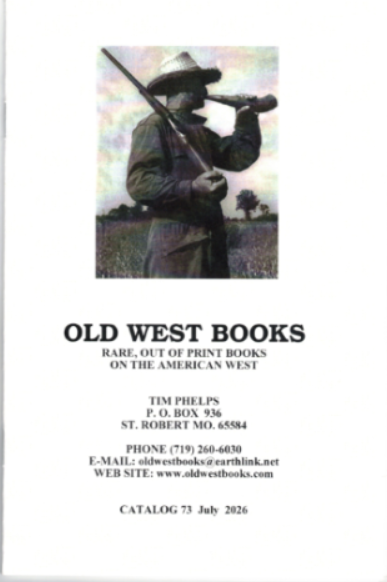
Old West Books recently published their Catalog 73 July 2026 of rare, out of print books on the American West. The Old West never gets old. Its legends live on, its history still pulls on our imagination. Here are some more books from Old West Books from that time and place that lives on in our memory, though none are left who actually lived those times.
Colorado doesn't have to do a lot to attract immigrants these days. Plenty of people want to live there with its spectacular beauty. In 1869, when suitable farmland was a greater priority, the mountains may not have had as much appeal. We begin with Colorado: Its Resources, Parks, and Prospects as a New Field for Emigration with an Account of the Trenchera and Costilla Estates, in San Luis Park, by William Henry Blackmore. It entices people with maps showing proposed railroads to the Pacific, more maps, and photos. There is a photo of Gov. William Gilpin. He was appointed by President Lincoln in 1861 and removed by him a year later. Gilpin then led a group of investors to buy a huge amount of land in south central Colorado which is probably why he appears in this promotion several years after leaving office. Despite the enormous growth since then in the Denver area, this part of the state still remains largely rural and might still welcome new settlers. Item 5. Priced at $1,250.
The Wild West this was not. The West was wild in 1872 when this book was published, but this journey was steeped in unbelievable luxury for such a primitive place. The book is Ten Days on the Plains by Henry E. Davies. Davies was a participant in this ten-day adventure. He was not a western explorer. He was a prominent New York City lawyer and assistant district attorney. He took on the job of writing an account. The host was Gen. Philip Sheridan, a military leader during the Civil War who then went on to fight Indians. Their guide was Buffalo Bill Cody. Others were various businessmen and dignitaries who could afford to participate. General Custer of Last Stand fame also participated. Fortunately, the buffaloes and other game did not shoot back. Six hundred buffalo paid with their lives for the amusement of the wealthy. One hundred cavalry men escorted the participants, and 16 wagons carried their luggage, supplies, ice, and, of course, wine. Roughing it was never softer. They traveled from Kansas all the way to Nebraska. How far can you go in ten days? This was the most ridiculous journey to the "Wild West" until that of Grand Duke Alexander that topped it the following year. This copy was inscribed by Davies to fellow participant R. W. Cameron, likely the New York shipping line magnate. Item 18. $9,500.
"There are not enough Indians in the world to defeat the Seventh Cavalry." That's an apocryphal quote from George Armstrong Custer. There is no evidence he ever said those words and yet it accurately expresses his attitude. He was filled with confidence or arrogance according to your perception. He was always successful until he wasn't. That came on June 25, 1876. On that day, he grossly underestimated the number of Indians he would face if he went to battle. This battle was as good as over before it started, though Custer did not realize it. Perhaps there was still time to retreat, or maybe not, when he realized his opponent was too strong to cross the Little Big Horn River as planned. He retreated to Last Stand Hill behind him (though naturally it was so named later). His troops fought as long as their ammunition and lives lasted, but they had no choice. They were surrounded and could not escape, and any attempt to surrender would have been futile. It was all over. Item 22 is Cyclorama of Gen. Custer's Last Fight Against the Sioux Indians, or Battle of the Little Big Horn with Grand Musee of Indian Curios Cyclorama Co. by A. J. Donnelle, published in 1889. It includes Sitting Bull's account of the battle. The winners get to tell the story. Item 22. $1,250.
John Evans Brown set out for California on March 15 of the Gold Rush year, 1849. He went with a group of Tennesseans searching for their fortunes. They reached their destination in September. Getting there was never easy for the 49ers. Brown kept a diary of his trip. His daughter, Mrs. Katie E. Blood, published his journal in 1907. It wasn't meant for a mass audience. She privately printed it for family in what appears to be a small number since the item is scarce. The book is Memoirs of a Forty-niner by His Daughter Mrs. Katie E. Blood. They traveled to Independence, after which it was through the plains wilderness. The party was hit with cholera and the captain and two others turned back. Then on to Scotts Bluff where they met "Rubedere" (Robidoux). Presumably, this was one of the Robidoux family for whom Robidoux Pass is named. Then it was on to South Pass, the Humboldt cut-off where another member of the party deserted, over the Sierra and into the gold fields. Brown noted, "Some of the Kentucky boys violated the Sabbath by taking a buffalo." You do crazy things in desperation. He says, "The Buffalos seemed to be very tame," not good for their well-being. The journal also speaks of dealing with Indians, other parties, stock, and water crossings. He also concluded that all immigrant guidebooks were worthless. This is notable collector Thomas Streeter's copy with his book label and pencil notes. Item 7. $5,250.
Jeremiah "Liver-Eating" Johnson had one of the more unusual nicknames. It was not because he was a good boy who willingly ate the disgusting liver his mother served him for dinner. The story is even darker than that. Johnson was a mountain man, who earned his way as a trapper, scout, occasional soldier, later deputy sheriff, and anything else where he could make a buck. The story now turns to something between the truth and exaggerated legend. It is said his wife, a Flathead Indian, was killed by a Crow Indian while he was off in the mountains trapping beaver. It set him off on a 25-year journey of revenge. He supposedly killed 300 Crow before making peace with them. What was notable about Johnson was that each time he killed a Crow, he would cut out their liver and eat it. Again, this was not because it was a gourmet dish. The Crow believed that the dead would never achieve lasting peace without their liver. After burying the hatchet with the Crow, he turned to his various respectable pursuits including being a lawman. Johnson died in 1900. Item 56 is Crow Killer the Saga of Liver-Eating Johnson, by Raymond W. Thorp, published in 1958. $150.
Old West Books may be reached at 719-260-6030 or oldwestbooks@earthlink.net. Their website is www.oldwestbooks.com.