Japanese Books, Illustrated Manuscripts & Scrolls from Jonathan A. Hill
- by Michael Stillman
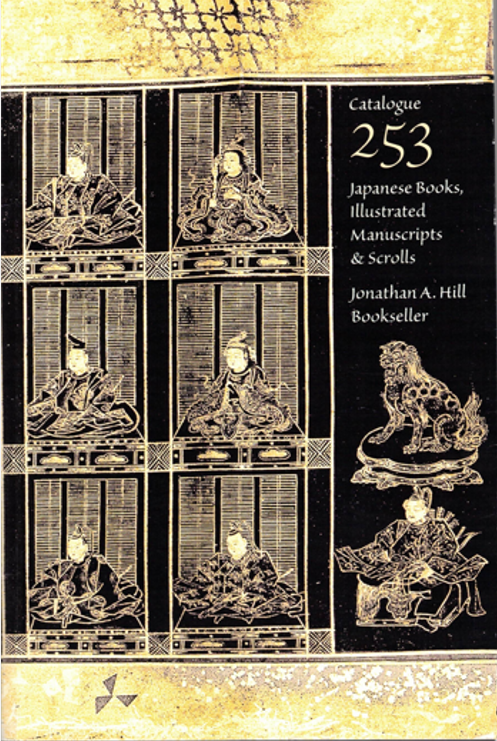
Japanese Books, Illustrated Manuscripts & Scrolls from Jonathan A. Hill
Jonathan A. Hill Bookseller has issued their Catalogue 253 Japanese Books, Illustrated Manuscripts & Scrolls. Many of these items go far back, to days before they were printing anything in America, even writing anything. It is somewhat surprising to find a collection of such significant Japanese material in America, but here it is. If you collect early Japanese material, you are unlikely to find another collection of this significance this side of the Pacific. Here are a few examples.
We begin with the first medical book printed in Japan. The title translates to Comprehensive Compendium of Medical Writings. It is dated 1528. Japanese medical historian Kosote Hiroshi described it as, "the most widely circulated medical book in the early to mid-Edo period (1603-1868). The significance of the Isho taizen for the history of medicine in Japan can therefore be considered extraordinarily profound." This was a period when medical knowledge was traveling from China to Japan at a rapid rate. Japanese physicians were traveling to China to learn the latest in the field. They brought back prescriptions which may or may not have been effective, that being not that different from medical prescriptions you get today. This book is very rare, with WorldCat locating only one incomplete copy. Item 34. Priced at $125,000.
This next item is sort of a map, though the fine colored paintings make it very different from the typical road map. The manuscript label translates to From Edo to Nagasaki in Bizen Province. It displays both the land and inland sea route. This was a major trade corridor during the Edo period. The item is a scroll which follows the route as it is opened. Hill describes the route as "the most important highway of the Edo period." They note that the scroll, "depicts in great detail and with manuscript labels: stations on the route; bridges; major castles; temples; and shrines; the palace at Kyoto; other notable buildings; important geographical features (including Mount Fuji partly shrouded in clouds); and towns and villages along the way. Distances are given, and travellers are well-depicted, showing their various clothing. Also shown are ships and skiffs in the nearby sea." Item 3. $12,500.
This remarkable orihon (an accordion style folding manuscript) depicts one of the most momentous events in Japanese history. From 1855, it depicts the arrival of American and Russian seamen to Japan and its forced opening to the outside world Japan long resisted. These are referred to as "black ship" items, unwelcome visitors who nonetheless stirred the curiosity of the long-isolated Japanese. The illustrations display the initial impressions of the Japanese to these strange visitors. There are 36 scenes depicting arrival and various activities by the Americans and Russians and their Japanese hosts. Item 21. $65,000.
This three-volume set illustrates and describes the burial sites of Japan's emperors. When the brother of Kotaku Hosoi undertook his study, many had fallen into disrepair. When the Shogun became aware of the situation, he had the sites fenced to preserve them. After his brother's death, Kotaku Hosoi created this study. The names of the emperors and locations of their graves, along with existing structures, are provided based on region. A third volume by Ban Nobutomo was added later. It too continues the illustrations of mausoleums. Item 7. $ 18,500.
Item 14 is two beautiful scrolls entitled on the inside of the holding box (translated) Sericulture Illustrated. Sericulture is the process of raising silk worms to produce, naturally enough, silk. The first scroll takes you through the production of silk, starting with incubating the eggs, chipping the mulberry leaves and feeding the larvae, and providing an environment that encourages them to spin their silk cocoons. The second covers taking filaments from the cocoons and processing them into silk threads, winding them onto spools, taking them to dying houses and processing them into silk suitable for weaving.
Jonathan A. Hill Bookseller may be reached at 917-294-2678 or jonathan@jonathanahill.com. Their website is www.jonathanahill.com.