Nineteenth century photography prices got a healthy boost and a major increase in interest with the recent auction of the Maillet Daguerreotype Collection at Christie’s on June 26. The sale featured the first public exhibition of the unique private collection. It consisted of 265 lots and realized total sales of $1,618,722. As the Christie’s press office bragged: (This sale was) “led by robust bidding with 51% new buyers to the category, and over 4,000 bids placed.”
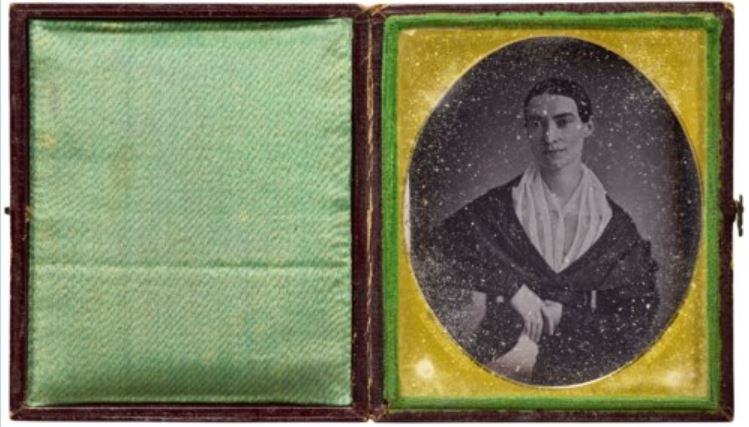
The top lot of the sale was Portrait of a Woman, c. 1840-41 by Robert Cornelius, which sold for $60,480— an impressive 20 times its low estimate, highlighting the strength of the market for historic and rare photographic works. Additional top lots include a group of works by Haiti-born Francis H. Grice, a Black American daguerreotypist, which sold for $40,320, a rare view of a Gold Mining Camp, c. 1850, which realized $37,800, along with Albert Stapfer's Chateau de Talcy, 14 October 1840, which realized $40,320, and a rare medallion-style portrait by Southworth & Hawes, realizing $32,760.
But the real story seems to be that the five priciest lots did not sell, while the rest of the collection literally flew out the door at astonishing multiples of presale estimates going from at least double to as much as twenty times the initial valuation.
Asked for comment, Darius Himes, Christie’s Deputy Chairman, International Head of Photographs responded with an informative July 24th email, “There were 400 daguerreotypes organized and sold as 265 lots. All but 11 lots sold, which was roughly 96% of the work offered.
“As you noted, nearly everything sold above the high estimate, apart from the top five lots. Those top lots failed to sell because, as we saw, they were estimated too high, meaning no one was willing to place a bid at the amount they were estimated at.
“The estimate for those works carried low estimates of $60,000 or higher. The reason they were estimated so high was based on the seller's wishes. Essentially, they were emotionally invested in a higher value for each of those works, and couldn't bear contemplating them selling for less than those amounts. There is a lot of psychology that goes into our line of work!).
“We were able to estimate the entirety of the rest of the collection in a way that was "attractive" to the market, and additionally, everything else had reserves that either started at $100 or slightly higher. Psychologically, a starting bid and reserve at $100 gets people really excited and invested in bidding, which drove the values up and up.
“That's the short version of some of the dynamics at play in an auction. The auction house can advise on estimates, etc, but ultimately we are trying to bring material to the marketplace in a way that will engage both established and new clients.
“The Maillets were very well known in the daguerreotype community, but essentially stopped buying in 1999. They scoured the field from the late 1960s through till 1999, and after that they tucked the work away and no one knew what they had. They were somewhat reclusive and just lived their lives out of the eyes of the collecting community.
“It took me and my team seven years of working with them to catalogue and organize the 400 works. Lynn Maillet died in 2022, and things were delayed at that point.
“Because they were well known, everyone was very curious to know what they had. They were known for having a great eye and sophistication in their collecting habits. And that drove the interest.
“When great collections come to market, they are "fresh" and people get excited. There is a community of daguerreotype collectors, and so they were all very supportive and excited. And of course Christie's is truly "the world stage" when it comes to presenting collections. That got a lot of attention. This dynamic happens with collections of all sorts of material. And of course we hope it creates more interest in the daguerreotype and other early photography.”
In an essay posted on Instagram and a longer version received as a pdf Christie's specialist Grant Romer observed, “Like many who became avid collectors of daguerreotypes, Lynn and Yann Maillet were struck by their first encounter with an actual example in an antique market. The material beauty of the object and unusual nature of the visual experience of the image—a perfect rendering of the actuality of seeing a living entity, fixed in time over one century past—moved them like no other photograph had.
“Further, they were surprised by the low valuation such a marvelous production was given—tens of dollars, not hundreds or thousands. They acquired it and, without an extensive background in photographic technology or academic history, began their journey to being true connoisseurs of the daguerreotype, that earliest viable form of photography. The impressive collection they built reflects their learning, their passion and a deep understanding of the many facets of the legacy of the daguerreotype.
“Unlike other of the transformative technologies that emerged in the nineteenth century, Photography, in the form of the daguerreotype, has a clear date of the beginning of public practice, that being August, 1839. The first truly viable photographic system, the world at large learned what photography was by the daguerreotype process, how to work it and what it was good for.
“They (the Maillets) began to vigorously devote themselves to collecting daguerreotypes at the beginning of the 1970s,” Romer continued. “They were not alone. Others realized that daguerreotypes were far more than just “old photographs”, “primitive, little pictures, difficult to see, of people, and places nobody knew or cared about”, or “historical curiosities, at best”. One often heard such opinions expressed by leading institutional curators who, at the time, were beginning to acquire other rare and fine 19th century photographs as Fine Art. They also sent out an occasional sales catalogue offering daguerreotypes and other photographs for sale, enjoying the trading aspect of the market and community.