








Rare Book Monthly

Articles - February - 2026 Issue

Can “Patriotism” and “History” Co-exist? The Smithsonian Case In Point

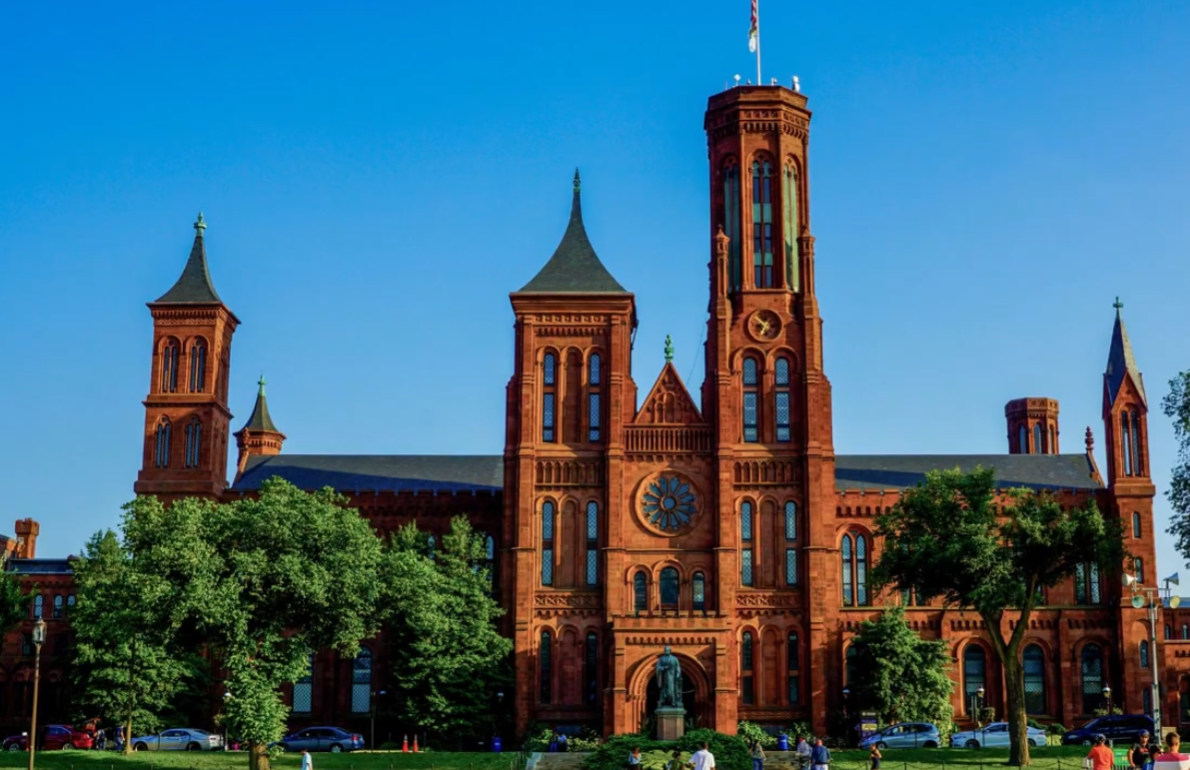
Smithsonian Institution Original Building.

Smithsonian Institution Original Building.

If you’re a history buff or a museum fan or anyone who thinks that the treasures of the past should be preserved and displayed you’ve no doubt read and heard about the current pressure on the Smithsonian. The story goes that the current administration would prefer to gloss over the less flattering episodes of the American past in favor of versions that are more flattering, uplifting, and patriotic. 

Don’t be a downer, goes the line, how can a little selective revision hurt. Wouldn’t that just be nicer for everybody all the way around?

The answer is “No,” not just a little No. Let’s hear a big NO, NO, NO!

When we are discussing the Smithsonian we are not just talking about one place:

According to their website: “The Smithsonian Institution—the world’s largest museum and research complex—includes 19 museums and galleries and the National Zoological Park. Currently, the total number of artifacts, works of art and natural science specimens in the Smithsonian’s collections is approximately 155 million. The bulk of this material—more than 145.8 million specimens and objects—is part of the National Museum of Natural History. In addition, Smithsonian collections include 162,000 cubic feet of archival material and 2.1 million library volumes.”

There are ones you know best like Natural History, Air & Space, African American and Native American located on the Mall in Washington, DC. But there are also other sites in NYC, and other parts of the country (link to list at the end), covering art, history, science, and culture for a diverse national collection.

It’s so big and it has so much, why would anyone object to a little tinkering with the content of the exhibits for political and ideological reasons? 

To put it bluntly: We teach our kids to tell the truth; we want our national museums to do the same.  

Let’s be clear on this - Smithsonian and all its parts is something we, as Americans, do well, really really well. This is our best stuff and these are our best people who put it together. It’s been around for awhile, and not just for a New York minute or two but since 1846. 

These are museums and exhibits we are proud of because they are interesting and accurate. They give a realistic informative look at our past and welcome all aspects of the American experience. 

When those same kids take their class trip to the nation’s capital, what do they want to see? I think you already know the answer.

So please, when it comes to fiddling around with the content, let’s get a grip.

To suggest that we do not love our country because we recognize there are parts of our past that have been less than glorious is, at the very least, intellectually lazy. 

Most Americans are indeed patriotic. We celebrate the 4th of July. We stand for the flag and fly it. Some of us even served in the US military. We actually know the words to the National Anthem and can recite the Pledge of Allegiance. Yes, there’s a place for “Stars and Stripes Forever,” there’s even a place for fireworks, banners, buntings, parades and Independence Day oratory. Most of us are 100% down for all of that. 

But there is no excuse for trying to steer the interpretation of our past so that only the shiny parts show. 

Being proud of our country and standing up for history as it really was are not mutually exclusive goals. And while we’re at it, let’s stand up for the people who have dedicated their lives to make it real and vivid for us, our children, family and visitors.

The traditional suggestions for what you can do to keep the Smithsonian great include writing to Congress, contributing financial support, rewarding professional expertise and promoting public awareness. Those are pretty boiler-plate suggestions.

But there’s nothing more American than word-of-mouth; so see if you can find a minute in the coming year to speak up to express your support for these great American museums and the great Americans who bring them to us. Talk to your neighbor, bring it up at coffee, mention it at scouts or after church. You’d be surprised how much good word-of-mouth can influence the outcome in situations like this one.

Do your part and be visible and vocal in your support, so when your kids get back from the class trip to DC and their eyes get all shiny talking about the Air and Space Museum, you can say, “Yeah, I know, I bet it’s even better than the last time I went.”

Here’s a list of all the parts of the Smithsonian and their holdings

https://www.si.edu/newsdesk/factsheets/smithsonian-collections

Read more about political pressure on the Smithsonian

New York Times (gift article) Jan. 8, 2026

https://www.nytimes.com/2026/01/08/arts/design/smithsonian-trump-pressure.html?unlocked_article_code=1.GVA.W03J.AZljbGockhEp&smid=url-share

Guardian Jan. 8, 2026

https://www.theguardian.com/us-news/2026/jan/08/donald-trump-smithsonian-reframe-entire-culture-united-states

Artnet News Jan. 13, 2026

https://news.artnet.com/art-world/smithsonian-funding-white-house-review-2735969


Posted On: 2026-02-01 03:07
User Name: midsomer

Where was your high horse when the statues came down?


Posted On: 2026-02-01 09:37
User Name: davereis

Good question, Midsomer., and this from a lifelong democrat. When so-called progressive dems (and many other dems) wanted to obliterate history by tearing down monuments, so many were right onboard. Most, but not all, were young democrats. The proposals somehow made them feel righteous. It was huge inexperience in life intersecting with cultural narcissism. But when the OTHER side (MAGA) wants to edit history to their liking, it is compared to fascism. By who? answer: By the same people who wanted to tear down the parts of history they disagreed with. So now, can any of us claim to be in the morally correct?


Posted On: 2026-02-01 22:30
User Name: jimmccue

Clearly the President should not be issuing executive orders to compel museums to do this that or the other, but the NYT story's phrasing is interesting: "The Trump administration’s campaign to pressure the Smithsonian into presenting a primarily positive view of America has been part of the president’s agenda since last March, when he issued Executive Order 14253, ’Restoring Truth and Sanity to American History.’ ” — for it doesn't seem unreasonable to ask the national museum to present "a primarily positive view" of the nation, and this is very different from saying that it must not present anything *other than* a positive view. Would the NYT prefer a primarily negative view?


Posted On: 2026-02-01 23:58
User Name: ae244155

Comparing museums and statues is a false comparison. Museums exist to tell us about history, statues and monuments are created to honor people. Americans should (and do) know about the Civil War and that should never be hidden, but we should not have statues in our town squares honoring traitors whose cause was to keep a part of the population (other than themselves, of course) in slavery, never to be free, in many cases beaten and brutalized, women raped by their masters. These people do not deserve to be honored, and the descendants of their victims should not have to see their statues, anymore than German Jews should be subjected to statues of Hitler. Fortunately, Germans don't do that. There is a good reason why there are no statues of Benedict Arnold, despite his great contributions to America before he turned traitor. The Confeds don't deserve better than he.


Rare Book Monthly

  • Leland Little, June 12: The First Illustrated Edition of Mary Shelley's Frankenstein.
    Leland Little, June 12: John Morton, Signer of the Declaration of Independence, Signed Pennsylvania Land Survey.
    Leland Little, June 12: The Scarce Jansson Edition of a Remarkable Early View of London.
    Leland Little, June 12: Signed Limited Edition of The Works of Sir Arthur Conan Doyle.
    Leland Little, June 12: Faden’s Important and Scarce Map of the Southern Campaign of the American Revolution.
    Leland Little, June 12: William J. Tate (NC, 1869-1953), Archive of the "Original host to the Wright brothers at Kitty Hawk.”
  • June 25, 2026
    Doyle, June 25: Houdini's biography, boldly signed. $3,000 to $5,000.
    Doyle, June 25: A volume from Abraham Lincoln's library, signed just before heading to Washington for his inauguration. $20,000 to $30,000.
    Doyle, June 25: A very early Confederate recruiting manual belonging to the chief commissary in Lee's Army. $600 to $800.
    Doyle, June 25: Rare hand-colored lithographs of the life of Napoleon. $20,000 to $30,000.
    Doyle, June 25: The "Holster Atlas" of the American Revolution. $5,000 to $8,000.
    Doyle, June 25: Jewish ceremonies in fine hand-colored engravings. $7,000 to $10,000.
    Doyle, June 25: A very rare work on Turkish military costume. $1,000 to $1,500.
    June 25, 2026
    Doyle, June 25: The most important illustrated work on the Mexican-American War. $10,000 to $15,000.
    Doyle, June 25: The finest illustrated book on Afghanistan. $10,000 to $15,000.
    Doyle, June 25: Henry Justice Ford St. George rescues the Princess from the horrible Dragon. $2,000 to $3,000.
    Doyle, June 25: A rare work of Prussian Army uniforms under Frederick William II, with exquisite hand-colored engravings. $800 to $1,200.
    Doyle, June 25: Lenny Bruce typed letter signed to a Village bohemian during his obscenity trials, with a manuscript note and drawing. $300 to $500.
    Doyle, June 25: Schiff's scarce Shanghai Sketchbook. $300 to $500.
    Doyle, June 25: The first accurate published representation of the American flag. $2,000 to $4,000.
  • Freeman’s
    How History Unfolds on Paper: Important Americana from the Eric C. Caren Collection, Part X
    June 30
    Freeman’s, June 30: [Queen Anne's War] Extraordinarily Large Manuscript Petition Signed by a Who's Who of Colonial New York Accomplished to Queen Anne. $8,000/12,000
    Freeman’s, June 30: [Mormonism] A Unique Manuscript Account of Joseph Smith's Final Words Offered to His Congregation, the Day Before his Violent Death, 1844. $8,000/12,000
    Freeman’s, June 30: [Baseball] [Mantle, Mickey] Mickey Mantle's First Cover: The Earliest Front-Page Newspaper Image of Mickey Mantle, "Something Good from Joplin". $8,000/12,000
    Freeman’s, June 30: [Baseball] A Striking Type 1 Press Photograph of Lou Gehrig's Hands. $8,000/12,000
    Freeman’s, June 30: [Declaration of Independence] One of the First Printed Announcements of American Independence, Subscriber Ebenezer Hazard's Copy, in the Exceedingly Rare Original Wrappers, 1776. $10,000/15,000
    Freeman’s
    How History Unfolds on Paper: Important Americana from the Eric C. Caren Collection, Part X
    June 30
    Freeman’s, June 30: [American Revolution] Born in the USA: First Day of Printing in the United States, July 4, 1776! $15,000/25,000
    Freeman’s, June 30: [War of 1812] "We Have Met the Enemy and They are Ours": The Critical Promotion of a Naval Hero, Oliver Hazard Perry is Appointed Master Commandant in the United States Navy, 1812. $40,000/60,000
    Freeman’s, June 30: [Star-Spangled Banner] Eyewitness Account of the Shelling of Fort McHenry in the War of 1812, in a Manuscript Logbook from the HMS Trave, Present at the Battles of Baltimore and New Orleans, 1814-16. $60,000/80,000
    Freeman’s, June 30: [American Revolution] Thomas Jefferson at the Birth of a New Nation: An Important Letter Carried by a Jewish Patriot Communicating the Definitive Treaty of Paris, January 16, 1784. $100,000/200,000
    Freeman’s, June 30: [Colonial America] [Plymouth Colony] Plymouth Colony Seeks a Royal Charter: A Rare and Important Plymouth Colony Document, 1690/91. $6,000/9,000
  • Sotheby’s
    Selections from The Jay T. Snider Collection of Benjamin Franklin
    Live Sale 24 June
    Sotheby’s, June 24: (Benjamin Franklin). The founding—and funding—of the Pennsylvania Hospital. $150,000 to $200,000.
    Sotheby’s, June 24: Benjamin Franklin, "the Day of the Declaration of Independence is everywhere annually celebrated”. $80,000 to $120,000.
    Sotheby’s, June 24: Benjamin Franklin, “probably the most fundamental thing ever done in the field of electricity”. $75,000 to $125,000.
    Sotheby’s, June 24: Benjamin Franklin. One of Franklin's very earliest surviving letters. $40,000 to $60,000.
    Sotheby’s, June 24: Roger More and Benjamin Franklin. The only complete copy known of Poor Roger. $25,000 to $35,000.
    Sotheby’s, June 24: John Jerman. The American Almanack ... for 1731 — the only known copy in private hands. $25,000 to $35,000.

Article Search

Archived Articles