Researchers Think Written Communications Began Far Longer Ago Than Previously Believed
- by Michael Stillman
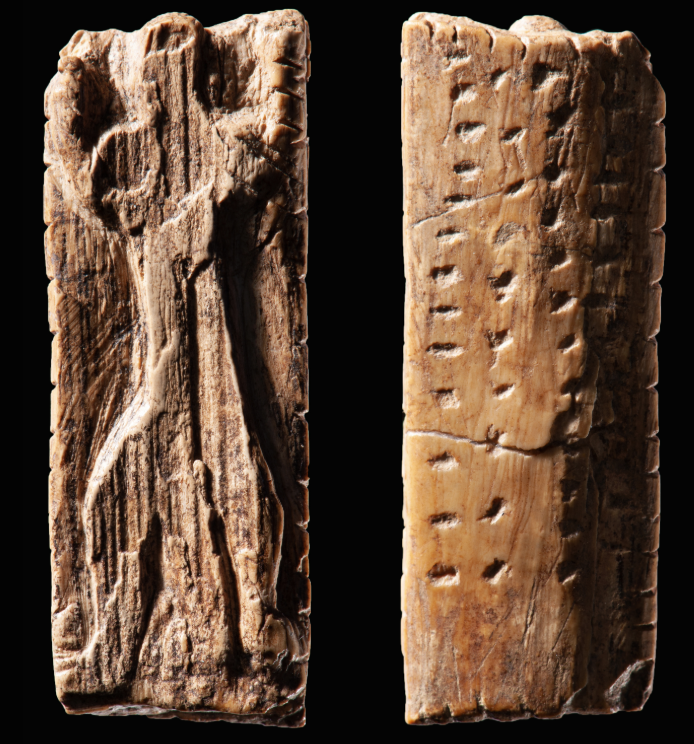
Carved symbols believed to be ancient writing.
We all know when printing began, at least on a mass scale as made possible by movable type. That came with Gutenberg around 1455. But, do you know when written language began? That, naturally, is much older.
The first writing has generally been accepted as being around 5000 years old. Cuneiform goes back to around 3,000 BCE, but proto-cuneiform may go as far back as 3,500 BCE. Now, a recent study out of Saarland University in Germany claims it goes back farther still, much, much farther. The authors of this study, Saarland Professor Christian Bentz and Berlin Museum of Prehistory and Early History archaeologist Ewa Dutkiewicz, date the earliest proto-writing to 40,000 years ago. That is a huge recalibration.
How did they reach this conclusion? It's not what you might think – the discovery of some ancient stone tablet deep underground in the layers of prehistory. Actually, it's been in front of our eyes for quite while. However, some more recent discoveries in caves in Germany made the evidence clearer to the researchers. They reached what to them was an unexpected conclusion when investigating objects found in these caves.
According to Saarland University, the researchers investigated 260 objects found in the caves, such as a carving of a mammoth or a figurine that is half lion and half human. Ewa Dutkiewicz explains, “the artefacts date back to tens of thousands of years before the first writing systems, to the time when Homo sapiens left Africa, settled in Europe and encountered Neanderthals.” They were able to date them to 34,000-43,000 years ago.
What they next evaluated were 3,000 signs found on these objects. In an article on the PNAS website, Bentz explained, “The inventory of sign types includes basic shapes such as lines, points, crosses, but also more complex patterns such as stars, grid patterns, and zigzag lines.” They concluded from the patterns that these marks were not the byproduct of some other activity, such as butchering, nor practical for such things as holes for attaching ropes. They also concluded that the information density of the signs indicated there was more to them than just decoration, though meaningful signs can also be decorative, such as with calligraphy.
Next, the researches digitized the sign sequences and ran them through some computer programs for statistical modeling, machine learning, etc. to look for repetition of sequences and compared them to early languages and writing. Bentz explains, “because of the high rate of repetitions and the high predictability of the next sign, we were able to show that the entropy – a measure of information density – is comparable to that of proto-cuneiform, which came much later.” That was the earliest known form of written communications. It used symbols for meaning rather than letters to form words. They are careful not to call what they found on these objects a written “language.” A written language, they say, mimics spoken language. Proto-cuneiform conveys messages, but is not something that can be spoken. The signs on these ancient objects they evaluated can't be spoken either. They are often very repetitive. That can relay a message, but no language has its speaker repeat the same word over and over in sequence. As the researchers say, “broadly defined, writing represents speech.” Perhaps this can be defined as a proto-written language, it can relay messages like language but cannot be spoken.
Bentz continues, “writing is only one specific form in a long series of sign systems.” He elaborates, “We continue to develop new systems for encoding information. Encoding is also the basis of computer systems.” That uses a system of zeroes and ones to convey unlimited amounts of information, but it is not a spoken language converted to writing.
If, then, this is information these early humans were intentionally recording, what does it mean? That is a question the researchers were unable answer. Dutkiewicz noted, “Stone Age humans had already reached a similar stage of development as modern humans. This means they likely had similar cognitive abilities as we do. The ability to record and convey information to others was extremely important for Palaeolithic humans.” In other words, they were as smart as us, they just didn't have access to the same information. The messages would not contain as deeply educated thoughts as they might today, but they wouldn't be baby talk or the grunts and groans of stereotypical cavemen. She says, “It may have allowed them to coordinate groups or even helped them survive.”
Some of the earliest writings involve numbers, trade accounts, inventory, or markings of time. Perhaps these 40,000-year-old marks represent some type of numerical accounting, but we don't know for certain. Perhaps we never will.
Heritage Auctions, Oct. 14: Bible, in English. Fine restoration binding in the style of the Queen’s binders.
Heritage Auctions, Oct. 14: Magnus Hundt, the elder. First edition of one of the earliest printed books with anatomical illustrations.
Heritage Auctions, Oct. 14: Agatha Christie. Cards on the Table. First edition.
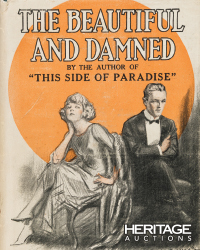
Heritage Auctions, Oct. 14: F. Scott Fitzgerald. The Beautiful and Damned. First edition, first printing.
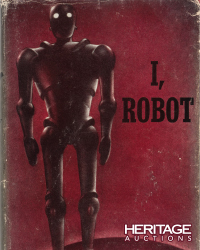
Heritage Auctions, Oct. 14: Isaac Asimov. I, Robot. First edition, presentation copy.
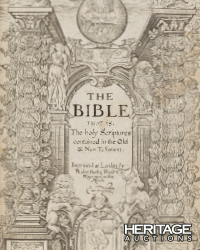
Heritage Auctions, Oct. 14: Bible, in English. Geneva-Tomson-Junius. London: Robert Barker, [colophon 1612]/1611.
Sotheby’s Original Film Posters 10 September 2026
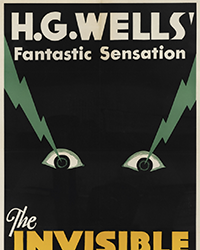
Sotheby’s, Sep. 10: The Invisible Man (1933). Extremely Rare US Leader Press One Sheet. £20,000 to £26,000.
Sotheby’s, Sep. 10: You Only Live Twice (1967). Italian Advance Quattro Fogli. £10,000 to £15,000.
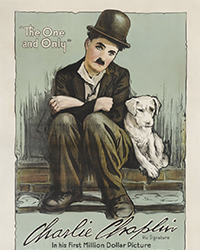
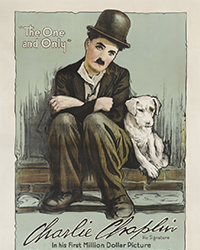
Sotheby’s, Sep. 10: A Dog's Life (1918). Extremely Rare US One Sheet. £50,000 to £70,000.
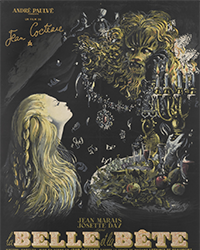
Sotheby’s, Sep. 10: La Belle et la Bête/Beauty and the Beast (1946). French Style A Grande. £12,000 to £18,000.
Sotheby’s, Sep. 10: Harry Potter and the Prisoner of Azkaban (2004). US Lenticular Prototype One Sheet. £10,000 to £15,000.
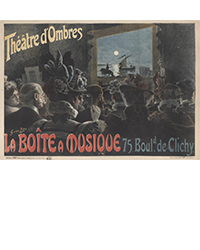
Sotheby’s, Sep. 10: Théâtre d’Ombres (1897). Exceptionally Rare French Poster. £8,000 to £12,000.
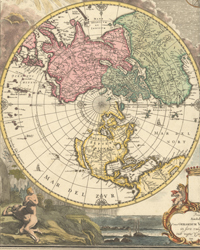
Old World Auctions (Sept 16): Lot 11. Blaeu's Superb World Map on a Polar Projection (1695) Est. $5,500 - $7,000
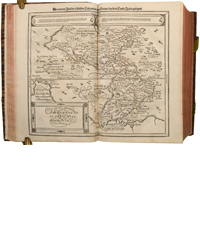
Old World Auctions (Sept 16): Lot 702. Munster's Largest 16th Century Edition, with Over 220 Woodcut Maps (1598) Est. $18,000 - $20,000
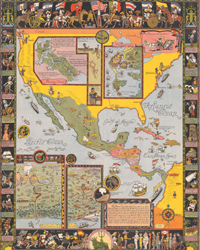
Old World Auctions (Sept 16): Lot 101. Rare Jo Mora "Carte" Showing a NYC-to-Seattle Route through Panama Canal (1933) Est. $900 - $1,100
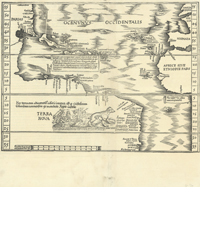
Old World Auctions (Sept 16): Lot 65. The Waldseemuller/Fries "Admiral's Map" (1541) Est. $8,000 - $9,500
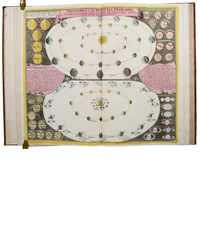
Old World Auctions (Sept 16): Lot 46. Contains all 30 Plates from Atlas Coelestis in Full Original Color (1742) Est. $16,000 - $18,000
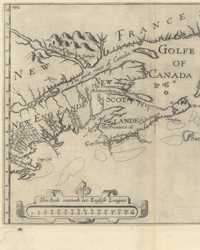
Old World Auctions (Sept 16): Lot 129. The First Map to Name New Scotland and Cape Cod (1625) Est. $8,000 - $9,500
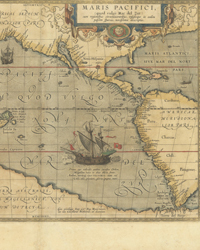
Old World Auctions (Sept 16): Lot 663. The First Printed Map Devoted to the Pacific in Full Contemporary Color (1589) Est. $7,500 - $9,000
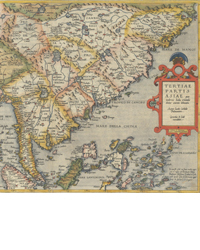
Old World Auctions (Sept 16): Lot 629. De Jode's Rare Map of Eastern Asia (1593) Est. $7,500 - $9,000
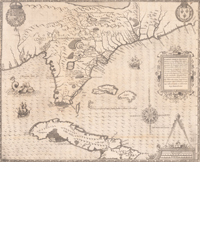
Old World Auctions (Sept 16): Lot 171. De Bry's Influential Map of Colonial North America (1591) Est. $11,000 - $13,000
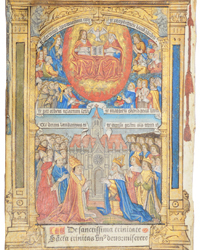
Old World Auctions (Sept 16): Lot 691. Superb Hand-Colored Image of the Holy Trinity (1502) Est. $800 - $950
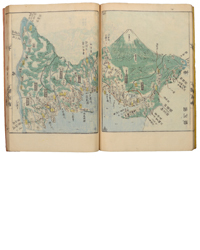
Old World Auctions (Sept 16): Lot 606. Important, Early Atlas of Japan with 75 Woodcut Maps in Printed Color (1837) Est. $2,000 - $2,300
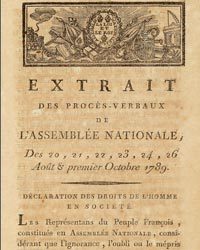
Koller, Sep. 16: FRANZÖSISCHE REVOLUTION - ASSEMBLÉE NATIONALE - Extrait des Procès-Verbaux de L'Assemblée Nationale, Des 20, 21, 22, 23, 24, 26 Août & premier Octobre 1789.
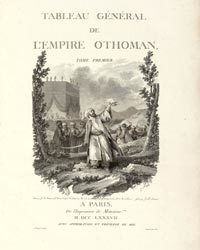
Koller, Sep. 16: MOURADJA D'OHSSON, IGNACE. Tableau général de l'Empire Othoman, divisé en deux parties dont l'une comprend la Législation Mahométane, l'autre l'histoire de l'Empire Othoman [... ]
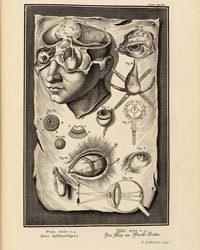
Koller, Sep. 16: BOTANIK - Blackwell, Elisabeth. A curious herbal, containig five hundred cuts, of the most useful plants, which are now used in the practice of physick.
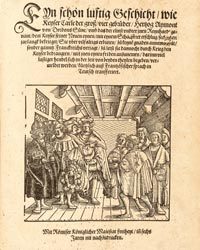
Koller, Sep. 16: HAIMONSKINDER – Eyn schön lustig Geschicht, wie Keyser Carle der groß, vier gebrüder, Hertzog Aymont von Dordons Süne [...]
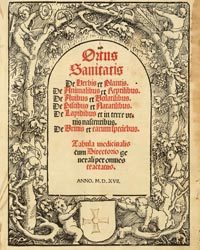
Koller, Sep. 16: KRÄUTERBÜCHER - HORTUS SANITATIS - [H]ortus Sanitatis. De herbis et plantis. De animalibus et reptilibus. De avibus et volatilibus. De piscibus et natalibus…
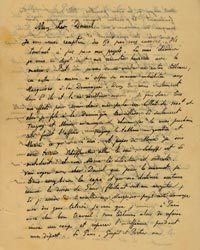
Koller, Sep. 16: GAUGUIN, PAUL, MALER (1848-1903). Eigenhändiger Brief mit Unterschrift und Couvert. An den Künstler und Freund Daniel de Monfreid in Paris.
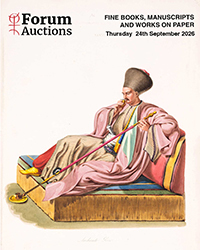
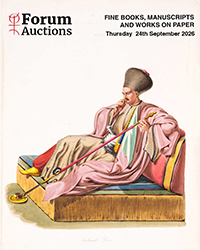
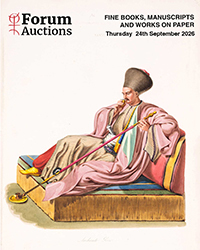
Forum Auctions Fine Books, Manuscripts and Works on Paper 24th September 2026
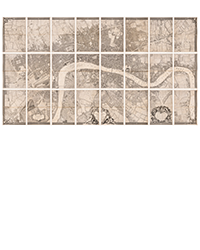
Forum, Sep. 24:A Plan of the Cities of London and Westminster and Borough of Southwark, 1746 [bound with] A Plan of the Cities of London and Westminster, [c.1755]. £30,000 - £50,000
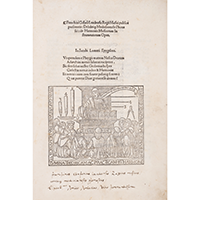
Forum, Sep. 24: Gafurius (Franchinus). De Harmonia Musicorum Instrumentorum Opus, first edition, Milan, Gotarto da Ponte, 1518. £20,000 - £30,000
Forum, Sep. 24: Tolkien (J.R.R.) The Hobbit, first edition, first impression, 1937. £10,000 - £15,000
Forum Auctions Fine Books, Manuscripts and Works on Paper 24th September 2026
Forum, Sep. 24: Stackelberg (Otto Magnus v). Costumes et Usages des Peuples de la Grece Moderne, first edition, Rome, 1825. £15,000 - £20,000
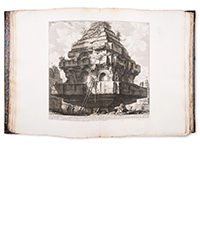
Forum, Sep. 24: Piranesi (Giovanni Battista). Le Antichita Romane, 4 vol., Rome, Bouchard and Gravier, 1756. £10,000 - £15,000
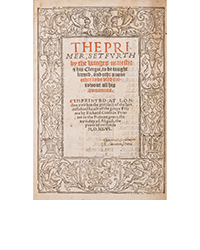
Forum, Sep. 24: Henry VIII's Primer.- Church of England.- The Primer, set foorth by the Kynges maiestie and his clergie…,, first edition, by Richard Grafton printer to the Princes grace, 1545; bound with 2 others, similar. £10,000 - £15,000
Forum Auctions Fine Books, Manuscripts and Works on Paper 24th September 2026
Forum, Sep. 24: Darwin (Charles). On the Origin of Species by Means of Natural Selection, fifth edition, ink inscription in the author's hand laid down to half-title, 1869. £6,000 - £8,000
Forum, Sep. 24: Siebold (P.F. von) J.G. Zuccarini and F.A.W. Miquel. Flora Japonica, 2 vol., first edition, Leiden, for the author, 1835-70. £6,000 - £8,000
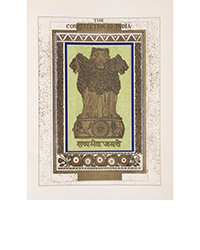
Forum, Sep. 24: Illuminated manuscript facsimile.- Constitution Of India (The), Dehra Dun, Survey of India Offices, [c. 1950]. £3,500 - £5,000
Forum Auctions Fine Books, Manuscripts and Works on Paper 24th September 2026
Forum, Sep. 24: Mao Tse-tung. Quotations of Chairman Mao, prototype edition, Shenyang, compiled and printed by the Political Department, Air Force Division of Shenyang Military Region, 1963. £3,000 - £4,000
Forum, Sep. 24: Richardson (John). Fauna Boreali-Americana; or the Zoology of the Northern Parts of British America, 4 vol., first edition, Norwich, Josiah Fletcher, 1829-37. £4,000 - £6,000
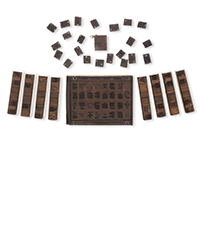
Forum, Sep. 24:Mite (The), the printer/publisher's own copy with the original type and printing blocks for all three of its editions (1891, 1893 & 1896), Grimsby, Ernest A. Robinson, 1891. £3,000 - £4,000.