Jean Mocquet (1575-1617) travelled the world, and he came back with an outstanding book full of pain, cannibalism and violence—and a few irresistible engravings. Do you think the world we’re living in is brutal? Then read Mocquet, and think again.
Drawn on the spot
The book itself is a classic—first published in Paris in 1617 under the title of Voyages en Afrique, Asie, Indes Orientales & Occidentales, it was reprinted in 1654 (Rouen), 1665 (Rouen), and even in 1830 (Paris)—it was translated into English in 1696 as Travels and Voyages Into Africa, Asia, And America... (Newton, Shelton & Chandler). We don’t know exactly who Jean Mocquet was, but he wasn’t exactly a nobody—in 1601, he was Henri IV’s apothecary, and close enough to the king to witness the latter’s clyster! His book is sought after nowadays, especially for the six wonderful engravings that come with it. They represent people Mocquet actually met, including some cannibal Caribe Indians feasting on severed human members—with the remains cooking in the background! As we speak, the French bookseller Camille Sourget offers an incredible copy for sale for €21,000 with gorgeous contemporary hand-coloured engravings—a rarity!
The 1830 Unusual Edition
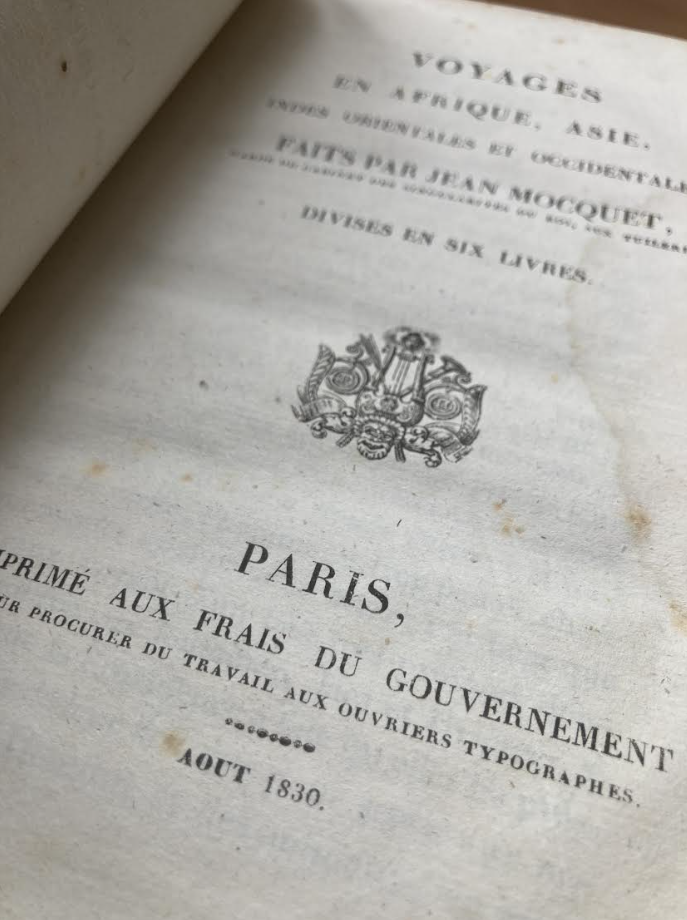
In 2026, Galerie Bassenge sold a regular copy for €1,250 (Rare Book Transaction History Search Results); Forum Actions sold a 1617 edition for GBP 800 while an English version was sold by Bonhams in 2012 for $3,500. The other day, I came across the unexpected 1830 edition! I had never heard about it—printed in Paris “At The Government’s Expense to Provide the Typographic Workers With Work—August 1830.” Unusual, to say the least. But August 1830 is the beginning of a new regime in France, La Monarchie de Juillet (1830-1848). Following the bloody July Revolution, Charles X is chased from power and replaced by Louis-Philippe. Those chaotic events had apparently put many printers out of work, and the new government was trying to help. The same mention appears on the reprint of Voyage du Sieur Champlain, ou Journal ès découvertes de la Nouvelle France (Paris, Août 1830). Unfortunately, those editions come with no plate. That actually stopped me from buying Mocquet’s book for a while. Plus, I feared he had remained on the surface of things—less than 400 pages for so many voyages? Come on... Yet the condition was attractive; so was the price—less than €100 when another professional offers it for €800 on his website. So I ordered it, and waited for it with low expectations. And then I started to read it.
Human Affairs
Mocquet didn’t travel for the sake of geography, but to report about human affairs. First, travelling at the time meant putting your life at risk. On his way to the East Indies in 1607, he wrote: “I suffered from the “louende” disease—the Portuguese call it “berber” and the Dutch “scurvy”—and my gums were all rotten, and bled a dark and smelly blood (...). Every day I had to cut my gums to let this bad blood run out. I’d also cut the gums above my teeth, going on the desk and holding a small mirror to see which parts I had to cut off. Once the bad flesh removed, I’d wash my teeth with my urine.” He miraculously survived, unlike other sailors “most of whom died helplessly behind some trunk on the deck, where the rats would eat off their eyes and the soles of their feet.” In the West Indies, he spent the night at King Camaria’s, a Caribe chief; and the sailor who went with him “couldn’t sleep at all, always fearing they’d come to eat us up.” Mocquet didn’t sleep that well either, he admitted, remembering the day when a woman from Camaria’s tribe “offered our captain a roasted human hand to eat, which he immediately pushed away.” Mocquet was also taken as a slave, beaten up, caught in the middle of sea battles, and nearly lost his life a dozen times—business as usual for a 17th century traveller.
Wicked From East to West
From East to West, Jean Mocquet met but wicked people: thieves in Africa, cannibals in America, murderers everywhere, and the Portuguese in Goa. Little is said about their slaves, but they went through hell. “The Portuguese tie them in irons and give them not 20 or 30, but up to 50 strokes! (...) At night in my room in Goa, I could hear the beating going on and the muffled cries of the victims whom they nag (...). Then they cut them with a razor blade and rub the wounds with salt and vinegar to prevent the worms to appear. They also have what they call “pingar vine”, which consists in cooking some bacon in a red-hot pan directly on the naked body of their victims (...). I’ve witnessed some of those cruelties with my own two eyes, and they deeply moved me—I’m still horrified by the sole thought of them.” PTS is a new name, but it has always existed.
Beware! This book might leave you with a PTS indeed, as it displays the raw truth. Men living like beasts, from the West to the East. And all things considered, no need to draw us an engraving here—we all know what Mocquet was talking about.
Thibault Ehrengardt