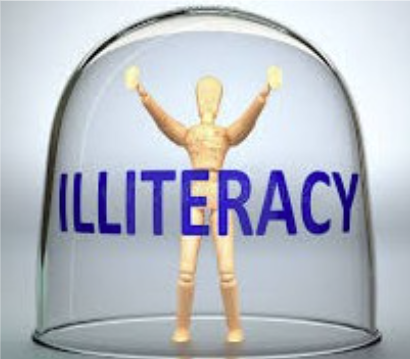
Functional illiteracy has increased dramatically in US children and adults. Whether you believe that as many as 40% of Americans are reading at the 6th grade level or below, or accept more conservative estimates, all sources agree that the arrow is pointing downward and declines first charted in 2013 are continuing.
Or as a May 13, 2026 New York Times article put it, "Almost everywhere in America, students are performing worse than their peers were 10 years ago, according to new, district-level test score data by the Educational Opportunity Project at Stanford.”
The alarming downward trends in reading levels, comprehension and critical thinking are coupled with equally disturbing news that the percentage of adults and children who read for pleasure is also falling. Just one of the many media sources noting this trend is a 2025 article in the Guardian claiming that reading for fun and personal enjoyment has plummeted by 40% in recent years.
These reports show up in traditional media but are also widely referenced more anecdotally in social media threads posted by educators. Whether it’s YouTube, TikTok, Instagram or Reddit, a casual search reveals a tidal wave of comments such as: "We are no longer assigning full books,” "They can’t read,” “They won’t read.” And even if they do read, ”the comprehension and reasoning skills aren’t there.”
As for writing, some claim “even a paragraph…five sentences” seems beyond the abilities of today’s students. At the same time student comments like, “Why do I have to learn how to read or write? AI will do it for me,” are common.
Educators continue to leave the profession citing “burn out,” while disillusionment greets the new graduates. Their social media posts reflect reaction to classroom chaos and a breakdown in virtually all sectors of basic literacy skills.
So what went wrong?
“The decline began well before the pandemic, so COVID-era disruptions alone cannot explain it,” Idrees Kahloon wrote in an October 2025 Atlantic article titled America is Sliding Toward Illiteracy.
“We are now seeing what the lost decade in American education has wrought. By some measures, American students have regressed to a level not seen in 25 years or more. Test scores from the National Assessment of Educational Progress (NAEP), released in 2025 show that 33 percent of eighth graders are reading at a level that is ‘below basic’—meaning that they struggle to follow the order of events in a passage or to even summarize its main idea. That is the highest share of students unable to meaningfully read since 1992.
“Among fourth graders, 40 percent are below basic in reading, the highest share since 2000. In 2024, the average score on the ACT, a popular college-admissions standardized test that is graded on a scale of 1 to 36, was 19.4—the worst average performance since the test was redesigned in 1990.”
“American schoolchildren,” he observed, “have given up almost all of the gains they achieved at the start of the century. These learning losses are not distributed equally. NAEP results show that the top tenth of students are doing roughly as well as they always have, whereas those at the bottom are doing worse. From 2000 to 2007, the bottom tenth of fourth graders in reading ability showed substantial improvement, before stagnating. But by 2024, those gains had been erased…”
This and other commentaries referenced a shift away from phonics and toward visual cueing as a teaching method as one reason for the decline. But Kahloon and others thought “a more likely culprit is smartphones. Jonathan Haidt, the social psychologist and author of The Anxious Generation, is the most prominent evangelist of this thesis. He argues that declining school performance and other worrying trends among Gen Z, such as the rise in anxiety, depression, and suicide, can be traced to the new ‘phone-based childhood.’ And his argument matches the time trend well.
“Smartphone ownership rocketed upwards around the time that American educational performance crested: In 2011, just 23 percent of teenagers had smartphones. By 2013—roughly the peak of American education—37 percent did. By 2015, 73 percent had access to one. And by 2018, that figure was 95 percent, where it remains today. Now, nearly half of teenagers say that they use the internet almost constantly.”
He, like many critics, also cites the Bush era No Child Left Behind approach as a factor, saying it… “was largely punitive, including threats of mandatory restructuring for institutions that failed to meet targets.” The result was that expectations rose but progress did not keep pace.
“If the incentives to learn decrease, children—just like adults—will respond to that,” Kahloon wrote. “One in four students today is chronically absent, meaning that they miss more than a tenth of instructional days, a substantial increase from pre-pandemic averages. Roughly 40 percent of middle-school teachers work in schools where there are no late penalties for coursework, no zeroes for missing coursework, and unlimited redos of tests.”
The quotes and summaries from the professional journalists do not even remotely begin to capture the frustration, anger and resentment bubbling up from those who must face these conditions in the classroom. His and other critiques largely ignore the role of parents and the massive education administrative bureaucracy as causes for the decline.
A summary of key literacy statistics for adults is equally disturbing. It reveals a deep divide in reading and comprehension skills across the population. The latest data shows that more than half of adults read below a sixth-grade level, with millions struggling to complete everyday reading tasks. Among the key statistics noted were:
- About 130 million U.S. adults (54% of those aged 16–74) read below a sixth-grade level, according to modeled estimates.
- Adults scoring in the lowest literacy levels (Level 1 or below) increased by 9 percentage points between 2017 and 2023.
- The average American reads at a 7th- to 8th-grade level.
Despite plentiful narratives documenting the decline and multiple possible causes, there is very little describing solutions that actually work and have a measurable impact.
A personal PS:
This writer has been a part-time reading tutor for 40+ years. Quite a few of the students here in Hawaii live in homes where English is not the primary language and parents are not able to help with school work.
Every child I’ve tutored came up to grade level but it took time and personal attention. I don’t profess any special powers, but I do know that learning to read, especially when the instructional resources were not easily available (as was the case here during the pandemic), is much harder.
Youngsters who were Pre-K, through the 1st grade during Covid frequently ended up in the 2nd grade when regular classes resumed. Going into the classroom, some for the first time, they couldn’t read, and soon found out what it was like to be tagged “slow,” “stupid,” or “special needs.”
One child I worked with in this age group did make it back to grade level, but it took time, personal attention, support from her parents and extra help from her school. And it cost money. Not every child is so fortunate.
Perhaps I’m from a different era, but I think learning to read, understanding what you read, and enjoying the experience is best accomplished in a one-on-one setting. You don’t have to be a genius to tutor reading, but it does have to be geared to the individual tastes and interests of the student. Practice, consistency and fun are the basic ingredients of becoming a reader. It’s not that hard and it turns out to be a rewarding experience for both the student and teacher. It’s heartbreaking to learn that today many teachers are required to teach from scripts, and seldom have the time or energy to really encourage a love of reading.
Back in the 1990s I had an assignment at Kamehameha Schools in Honolulu, one of the wealthiest private school systems in the country. I admired their emphasis on early childhood education. I met one of their best kindergarten teachers working in one of Oahu’s poorest neighborhoods, yet most of her kids exceeded national norms.
I was surprised to learn she did it with singing. Almost every lesson had a song. Almost every song had a solid vocabulary. Many entered the program at the 20th percentile or even lower, they mostly left at grade level. By the time they left her classroom they liked to read and they all liked school.
—---------------------------
Atlantic article March 2025, America is Sliding Toward Illiteracy
https://www.theatlantic.com/ideas/archive/2025/10/education-decline-low-expectations/684526/
Workaround paywall for Atlantic article https://archive.ph/SbUdP
Guardian article describing decline in reading for pleasure https://www.theguardian.com/us-news/2025/aug/20/reading-for-pleasure-study
Summary of key deficits in adult literacy
https://www.nu.edu/blog/49-adult-literacy-statistics-and-facts/
(Gift article - no paywall) May 13, 2026 NY Times articles on recent literacy test scores with many charts and graphs.