“I have collected rare Americana for 46 years and my greatest joy was in studying the most remarkable American, Benjamin Franklin, and reconstructing his life through this collection.” Those are the words of Jay T. Snider, one of the great collectors of Americana. His collections have encompassed all of America, his home of Philadelphia, and now Philadelphia's favorite son, Benjamin Franklin. His collection has enabled Snider, and all of us, to better understand this complex and great man, who seemingly could do anything he wanted. Sotheby's described him as, “a book and almanac publisher, civic leader and scientist, postmaster, diplomat, man of letters and elder statesman.” You can add inventor to those. Sotheby's will be presenting the sale of the Jay T. Snider Collection of Benjamin Franklin on June 24, 2026.
Sotheby's says of this collection, it is “the greatest private collection of material related to Benjamin Franklin to be formed over the last century.” There are 156 items covering the full span of his career. Items offered include printed ephemera, books, letters, newspapers, almanacs, manuscripts and artifacts. Franklin's children did not do much to protect his work. His was a somewhat disfunctional family. His surviving son remained a loyalist during the Revolution. Franklin never forgave him and left him very little. The result was that many of his papers were strewn about, rather than ending up in an institutional collection. Jay Snider has done an amazing job of finding so much of it. Forty-six years of collecting is helpful.
The sale is presented chronologically, from his early days of making a name for himself to his later years as an elder statesman (but still with the roving eye of a young man). The first and earliest on this list is The American Almanack For the Year of Christian Account 1731, published by Franklin and his then partner Hugh Meredith in 1830. Franklin was 24 years old at the time, already having moved to Philadelphia from his birthplace in Boston. This is the earliest surviving almanac printed by Franklin and the only copy known in private hands. Sotheby's has estimated the price at $25,000-$35,000.
This is one of the earliest surviving Franklin letters, dated June 12, 1738. It's from his days as a bookseller. It is to John Ladd confirming his purchase of some books from Franklin, The Ladies Library and remaining two volumes of an edition of Don Quixote. He also offers Ladd some recently arrived books and promises he “will not part with them until I hear from you.” They are editions of the Iliad and Odyssey translated by Alexander Pope. This is the third oldest surviving complete Franklin letter and the earliest in private hands. Estimated $40,000-$60,000.
Here is a Franklin imprint, printed and sold by Franklin and D. Hall in 1748. It is a justification of war in self defense, an answer to religious pacifism. The title is A Treatise On the Lawfulness of Defensive War, by William Currie. Estimated $3,000-$5,000.
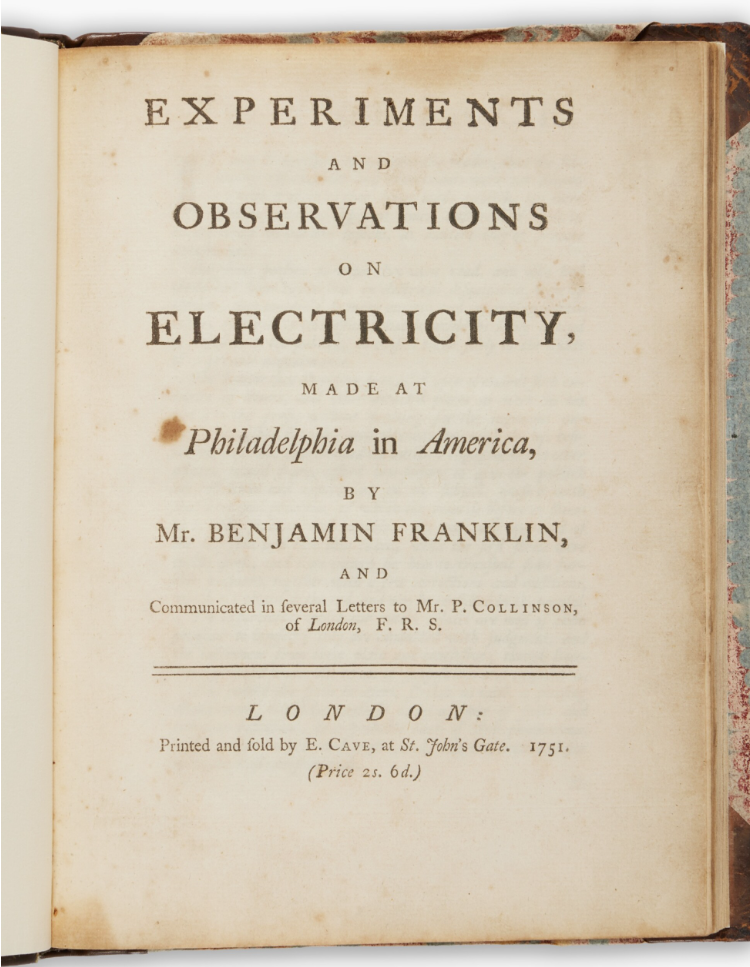
This book is from Franklin as the great scientist. It was described by Printing and the Mind of Man as “The most important scientific book of eighteenth-century America.” Noble Prize winning physicist Robert Andrews Millikan adds, “probably the most fundamental thing ever done in the field of electricity.” The title is Experiments and Observations on Electricity Made at Philadelphia in America, printed in 1751. It was not printed by Franklin as he had moved on from the printing business. This book contains his famous kite and key experiment where he identified the nature of lightning. Estimated $75,000-$125,000.
Benjamin Franklin wrote to his close friend, Joseph Galloway on June 10, 1758. Franklin was in London at the time. Galloway was a member of the Pennsylvania Assembly. They corresponded on plans for the colony and Philadelphia. There were issues about whether William Penn's descendants could be taxed. There was also the typical intrigue that goes on in politics. Galloway would later propose compromises that dealt with the issues the colonists had with Britain. He was sympathetic to the colonists. Galloway would go on to be a member of the First Continental Congress and the correspondence between the two allies continued. However, Galloway remained loyal to the Crown, even if he wanted reforms. He proposed a plan of reconciliation but it was rejected. As the Pennsylvania Assembly became more radical, he dropped out, and he declined to participate in the Second Continental Congress. In his final letter to Galloway in 1775, Franklin urged his old friend to stay involved. When the colonists declared their independence, Galloway remained loyal to Britain, serving in a top civilian position in Philadelphia after it was conquered. When the British retreated, Galloway retreated with them to New York and then to England. He never returned and his friendship with Franklin was severed, also never to return. Estimated $70,000-$100,000.
Benjamin Franklin became friends with Mary “Polly” Stevenson when he boarded with her mother in London in 1757. Stevenson was 33 years his junior, but both were intellectually gifted and “Polly” asked him to tutor her. They remained good friends and correspondents the rest of his life. There was no indication of any romantic relationship and Franklin was always proper, even though he could flirt. He would have liked to have seen his son, William, marry her. Stevenson married another, a marriage that did not last. It did not interfere with their relationship. She wrote Franklin on July 3, 1785, signing the letter with her married name, Mary Hewson. She was planning her move to America. She writes that she is happy to hear that he had a good journey to France on his way to America. She continues, “Accept my wishes that the remainder may be equally prosperous, and that we may meet again in America.” She concludes, “Adieu my dear Sir! Be assured of constant grateful affection.” She was with Franklin and his family when he died in 1790. Estimated $2,000-$3,000.