• Freeman’s, June 30. Thomas Jefferson’s “Birth of the New Nation” letter, carried to Paris with the Treaty of Peace, by a Jewish patriot. $100,000-200,000.
    Freeman’s, June 30. “The rockets’ red glare.” A British midshipman’s log recording the bombardment of Fort McHenry. $60,000-80,000.
    Freeman’s, June 30. The Critical Promotion of a Naval Hero, Oliver Hazard Perry Commission signed by James Madison, 1812. $40,000-60,000.
    Freeman’s, June 30. Born in the USA: First Day of Printing in the United States, July 4, 1776. $15,000-25,000.
    Freeman’s, June 30. One of the Earliest Printed Announcements of American Independence, in the Exceedingly Rare Original Wrappers, 1776. $10,000-15,000.
    Freeman’s, June 30. "The Two Big Guns of the N.Y. Yanks": A Striking Type 1 Press Photograph of Lou Gehrig's Hands. $8,000-12,000.
    Freeman’s, June 30. A Unique Contemporary Manuscript Account of Joseph Smith's Final Words to His Followers, the Day Before his Violent Death. $8,000-12,000.
    Freeman’s, June 30. The State of Minnesota Officially Certifies the Fourteenth Amendment to the Constitution Of the United States. $8,000-12,000.
    Freeman’s, June 30. Extraordinarily Large Manuscript Petition Signed by a Who's Who of Colonial New York to Queen Anne from the Colony of New York. $8,000-12,000.
    Freeman’s, June 30. Mickey Mantle's First Cover: The Earliest Front-Page Newspaper Image of Mickey Mantle, "Something Good from Joplin". $8,000-12,000.
    Freeman’s, June 30. A Call to Arms in the Months Following the Declaration of Independence: An Early Continental Army Recruitment Poster. $6,000-9,000.
    Freeman’s, June 30. Samuel Jones, the Statesman Behind the Newly Discovered "Jones Declaration": His Annotated Set Used in His Working Law Library. $6,000-9,000.
  • Sotheby's Book Week
    2 June - 9 July
    Sotheby’s, June 25: Smith, Adam. The Wealth of Nations, on its 250th anniversary. $180,000 to $250,000.
    Sotheby’s, June 17: Fontana, Lucio. Concetto Spaziale. 1967. Leporello en papier doré. Bel exemplaire signé. €4,000 to $€,000.
    Sotheby’s, June 25: Fitzgerald, F. Scott. "So we beat on, boats against the current, borne back ceaselessly into the past”. $150,000 to $200,000.
    Sotheby’s, June 25: Washington, George (as First President). Washington decries “an ostentatious imitation, or mimickry of Royalty” in his Presidency. $250,000 to $500,000.
    Sotheby’s, June 17: Lope de Vega. Rare manuscrit autographe signé de la préface dédicatoire de "El Cardenal de Belen" (le cardinal de Bethléem), pièce composée en 1610. €40,000 to €60,000.
  • June 23rd, 24th & 25th 2026
    Fonsie Mealy’s, June 23-25: Medical Incunabula: Petit (Jean)publisher & Kerver (Thielman)printer. Regimen Sanitatis Salernitanum, sm. 8vo, Paris [1498]
    Fonsie Mealy’s, June 23-25: Hugo (Victor) [Wraxall (Lascelles)]. Les Miserable, 3 vols., 8vo, L. (Hurst & Blackett) 1862, First Authorized English Translation (copyright).
    Fonsie Mealy’s, June 23-25: Shelley (Mary Wollstonecraft). Frankenstein: or The Modern Prometheus, 8vo, 2 vols. in one, L. (G. & W.B. Whittaker, Ave-Maria-Lane) 1823.
    June 23rd, 24th & 25th 2026
    Fonsie Mealy’s, June 23-25: Cuisine: Anon. Cookery, Pastry, and Sweet Meats in three Books, Alphabetically Digested, 8vo 1710.
    Fonsie Mealy’s, June 23-25: Lambert (Aylmer Bourke). A Description of the Genus Pinus, with Directions Relative to the Cultivation…, 2 vols. Sm. folio L. (Messrs. Weddell) 1832.
    Fonsie Mealy’s, June 23-25: Botany: Curtis (William). Flora Londinensis: or Plates and Descriptions of such Plants as Grow Wild in the Environs of London, 2 vols. folio, London (B. White) 1777 – 1798.
    June 23rd, 24th & 25th 2026
    Fonsie Mealy’s, June 23-25: Le Moire (J.M.) Maple Leaves, Canadian History and Quebec Scenery (Third Series) 8vo Quebec (Hunter, Rose & Co.) 1865. First Edn.
    Fonsie Mealy’s, June 23-25: The Earliest Extant Printed House Contents Sale Catalogue in Ireland: Baillie, Auctioneer, Abby Street. A Catalogue of the Goods and Stock of the late Edward Wingfield…
    Fonsie Mealy’s, June 23-25: William III King of England. Autograph Letter Signed ("William R") to an unnamed correspondent [possibly Charles-Henri de Lorraine] discussing his strategy against the French forces during the siege of Namur.
    June 23rd, 24th & 25th 2026
    Fonsie Mealy’s, June 23-25: [Austen (Jane) (1785-1817]. Pride and Prejudice, 3 vols. sm. 8vo, L. (T. Egerton) 1813.
    Fonsie Mealy’s, June 23-25: Heaney (Seamus). Ugolino, sm. folio D. (Dolmen) 1979, Limited Edn. No. 78/125 Copies, Signed by Seamus Heaney, Louis le Brocquy, Liam Miller and Andrew Carpenter.
    Fonsie Mealy’s, June 23-25: Voltaire (F.M. Avouet de). Petits Ouvrages, attribues a M. de Voltaire, sm. folio manuscript, dated 1776, containing 9 works.
  • Bonhams, June 14-23: Franklin D. Roosevelt Presentation Gold Pocket Watch. Estimate: $20,000 - 30,000
    Bonhams, June 14-23: Presentation Copy of the First Issue of the Lincoln Douglas Debates Signed by Abraham Lincoln in Pencil to a Sangamon County Illinois Republican. Estimate: $150,000 - 250,000
    Bonhams, June 14-23: A Senate Resolution Signed in the Tense Days After the Union's Humiliating Defeat at the First Battle of Bull Run. Estimate: $80,000 - $120,000
    Bonhams, June 14-23: Seven Passages to a Flight, an Artists Book with a Story Quilt by Faith Ringgold, the Publisher's Own Copy. Estimate: $80,000 - 120,000
    Bonhams, June 14-23: A New Charter for Virginia, A Response to the First Armed Rebellion in the American Colonies. Estimate: $15,000 - 25,000
    Bonhams, June 14-23: Earliest obtainable printing of the Bill of Rights. Estimate: $8,000 - 12,000
    Bonhams, June 14-23: Edward Curtis Orotone. Estimate: $7,000 - 9,000
    Bonhams, June 14-23: Owned by Jacqueline Kennedy Onassis: A Butter or Dessert Plate from FDR's State Dinner Service. Estimate: $3,000 - 5,000
    Bonhams, June 14-23: An Early Large-Format Plan of the City of Washington. Estimate: $1,500 - 2,500
    Bonhams, June 14-23: Containing the First Map to Name the Hudson River. Estimate: $20,000 - 30,000
    Bonhams, June 14-23: America's First Major Novelist, a Complete Chapter in Autograph Manuscript by James Fenimore Cooper. Estimate: $15,000 - 20,000
    Bonhams, June 14-23: The Only Full-Length Book by Jefferson, with the Justly Famous Map. Estimate: $12,000 - 18,000

Rare Book Monthly

Articles - June - 2026 Issue

A Forgotten Notebook Reminds us about a Crossroads. Are we there again?

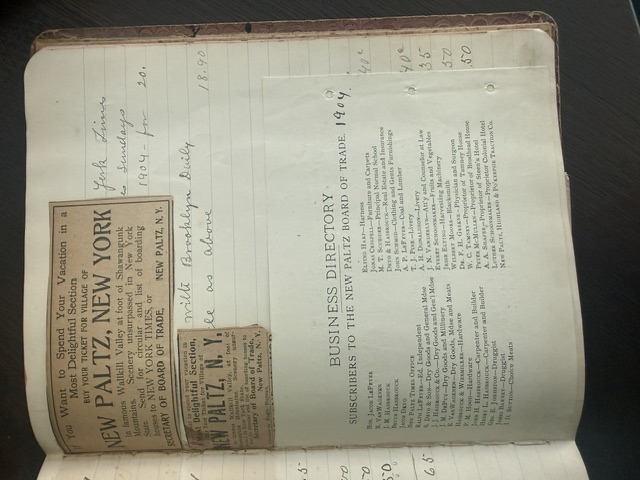
Years ago, I bought a shopworn unpromising notebook that contained minutes and sundry clippings that told the story of a group of concerned citizens who wished to establish a Board of Trade for the community of New Paltz that had about 275 male adult residents. Almost half joined this effort. The first entry was dated May 7, 1900, and the last January 28, 1917. On 105 handwritten pages, the story of New Paltz’s emergence in the 20th century is told.


The community was hoping to become part of greater New York. This is a portion of their rarely remembered story. Once read, it ends with a consideration of the future. 
 

At the turn of the 20th century, New Paltz was transitioning from a quiet two-hundred-year-old agrarian Huguenot settlement into a bustling village, connected by the Wallkill Valley Railroad running eight passenger and freight trains a day north and south, there anchoring the recently opened New Paltz-Highland Trolley running east toward Highland and Poughkeepsie. Soon cars and trucks would begin to replace horses. What they had had in their past was – pastoral isolation, now giving way to breathtaking possibilities of inclusion, if the men of New Paltz could grasp the reins of America’s run-away growth. The setting was bucolic.  Lake Mohonk and Minnewaska, both regional resorts commanding 20,000 acres together on the Shawangunk ridge, offered an epicurean alternative to New York’s unrestrained intensity. New Paltz’s futurists believed New Paltz could emerge as the bucolic alternative to New York’s froth. The New Paltz Normal School would be where both worlds would meet.


How could New Paltz join the 20th century? It seemed it had, except by comparison to the Empire State City that already was becoming known as Gotham. New York was already the world’s second largest city by 1900 and would become the largest by 1925. New Paltz had long been in the penumbra of Gotham’s explosion of culture, cultures and ingenuity. 


Employing the concept of a steamboat invented in France, Fulton quickened travel on the nearby Hudson River in 1807. Samuel Morse of Poughkeepsie first demonstrated Morse code in 1837. The railroad airbrake invented in Schenectady in 1869 by George Westinghouse quickly increased both speed and safety of train travel. A mere one hundred and sixty miles east on March 10, 1876, it was there that Alexander Graham Bell first spoke into his handset, “Mr. Watson, come here, I want to see you!”  The phonograph was invented in 1877 and the light bulb 1879 at Menlo Park, N. J. 105 miles away by Thomas Edison. New Paltz was living in the century of big ideas. Everywhere around them the world was on fire. The men of New Paltz wanted to play their part. How?
 

The response of the men of New Paltz, midway between New York City and Albany at the year of 1900, was their determination to bring their community to the attention of the larger world.  It was both simple and beautiful. Don’t lock the gates and offer a welcoming smile.


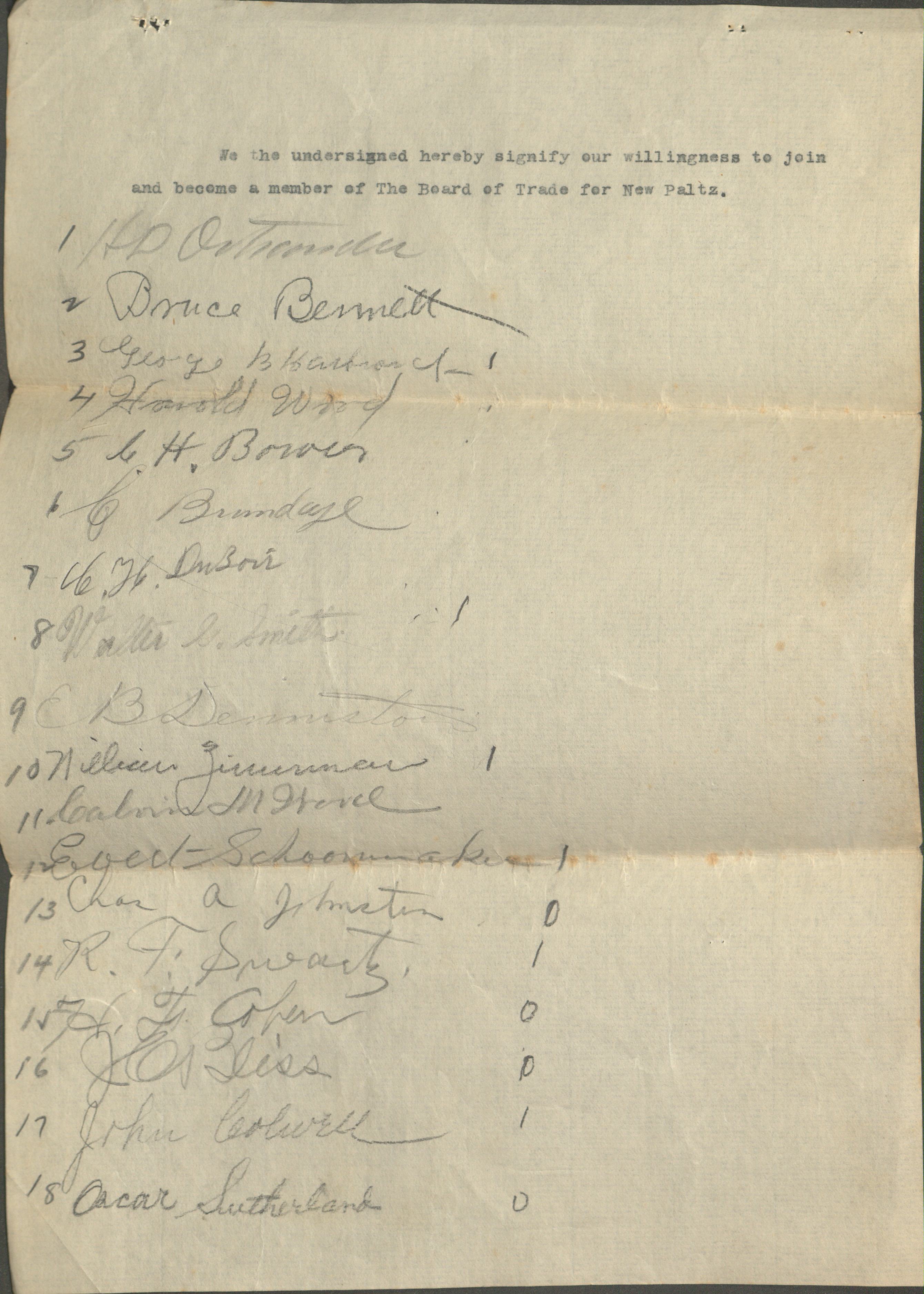
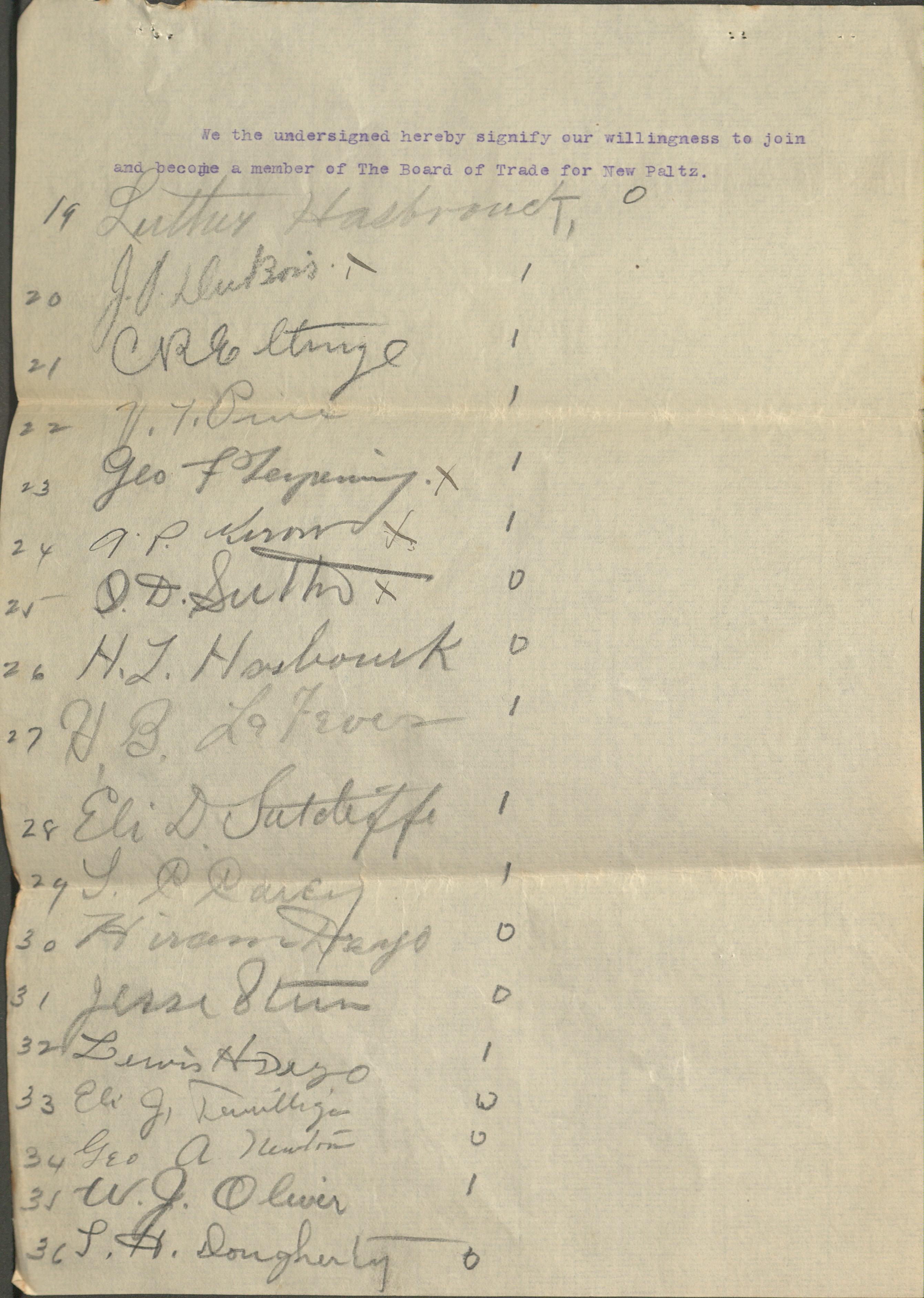
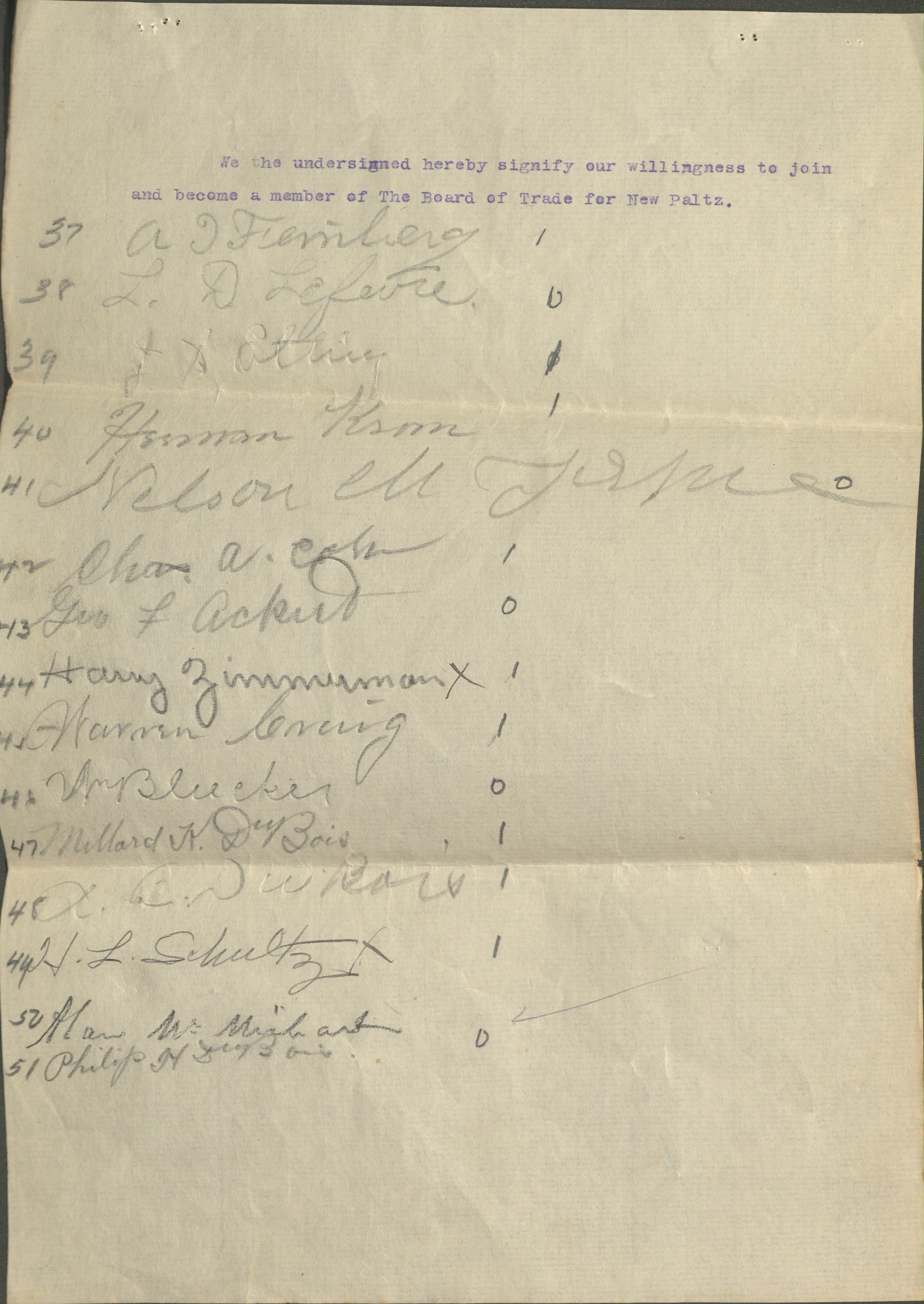
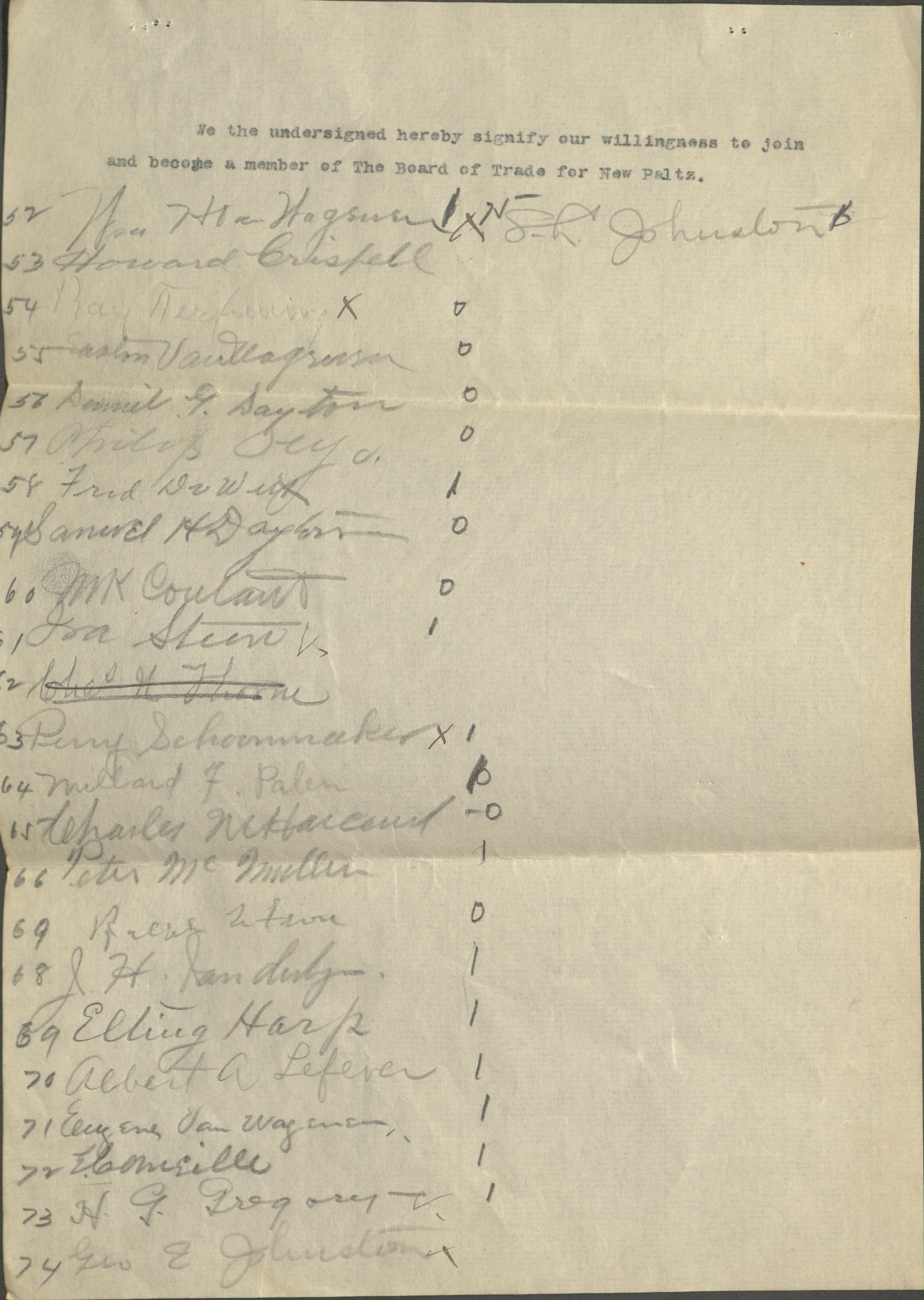
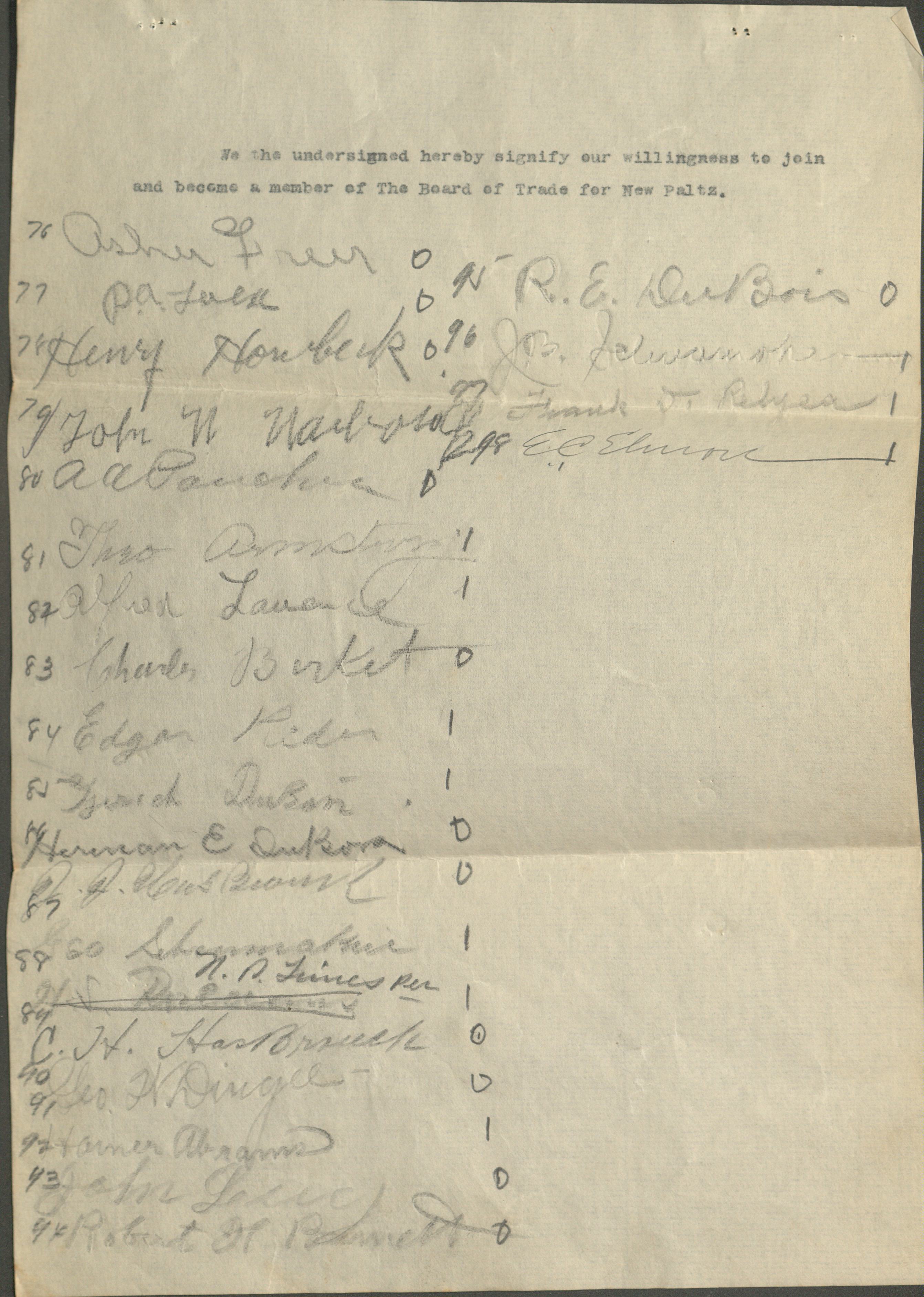
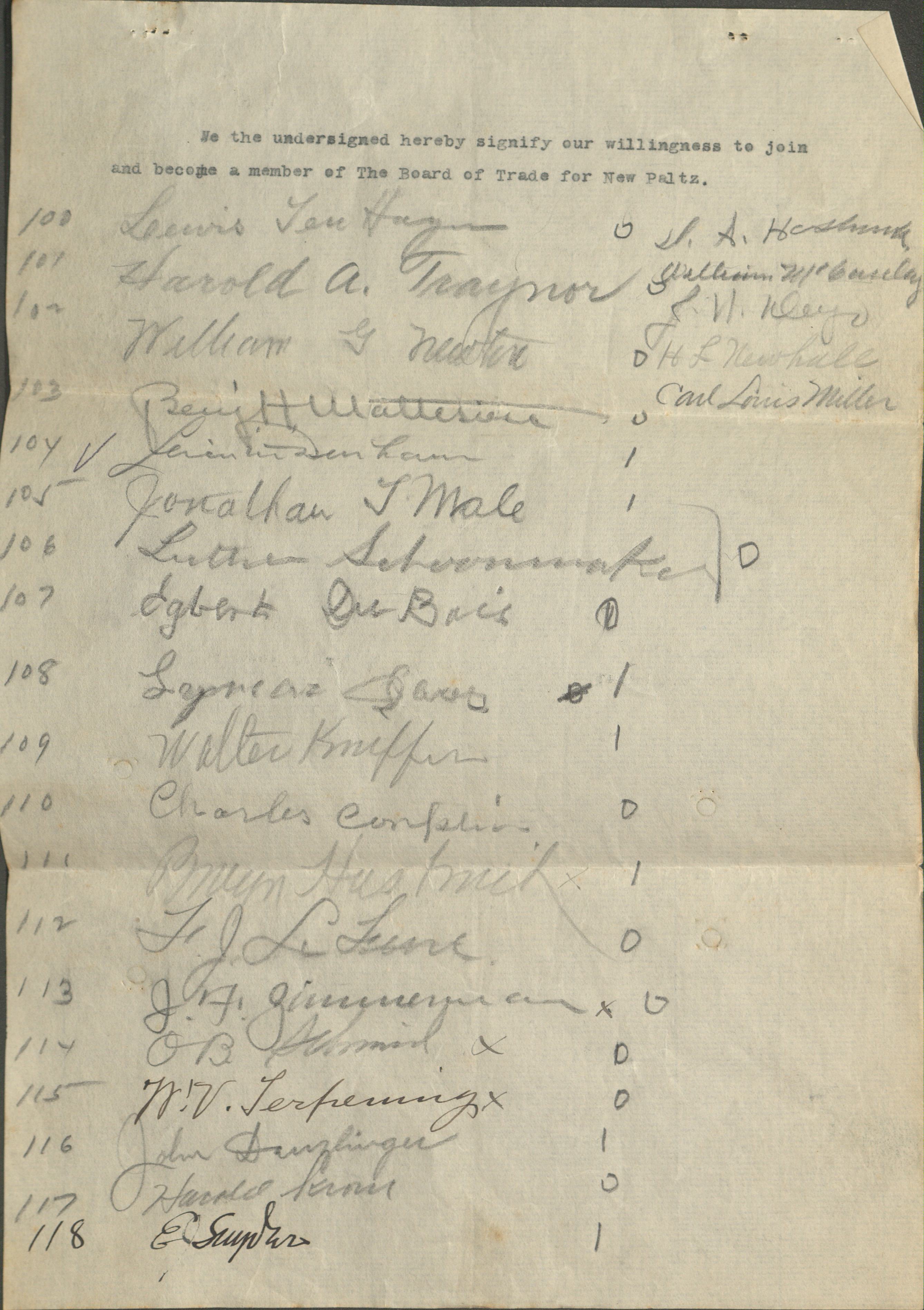
The gentlemen of New Paltz, according to the minutes of their soon to be organized Board of Trade, were determined to put New Paltz on the map by influencing policy and occasionally advertising in distant newspapers. Their very first action was to circulate a petition to affirm how many persons (and businesses) would be prepared to pay $5.00 annual dues to fund these plans. At the May 31st, 1900, meeting, a printed and handwritten list of 49 names was appended. Laid in separately, within their handwritten records was their organizing petition, soon signed by 123 brothers in faith. Be the undersigned hereby signify our willingness to join and become a member of the Board of Trade for New Paltz. Among the signers were the Principal of New Paltz Normal School, many merchants, many representatives of the founding families and the village’s leadership. 


On July 10th they made their first investment in promotion. “Motion carried that Secretary (would place) advertisements” in New York (City) newspapers promoting the New Paltz Summer Boarding Houses in New York papers for 3 weeks long. From a close reading of the plan, it’s clear they balanced on the highwire between word ads and display advertising and examined their budget and embraced the mercantile notices.  We today know them as classifieds.
 

The next entry dated May 10, 1901, the Board of Trade membership learned the committee was holding $138.68. They then wished to promote the summer businesses in the same ways they did in year past.


Over the next five years, there were 2 or 3 brief meetings each year to talk about their limited resources and how to increase and spend them. The June 12th, 1904, meeting they provided a printed list of “Subscribers to the New Paltz Board of Trade. They were making progress!


Hom. Jacob LeFever

N. VanWagenen

J. M. Hasbrouck

Bruyn Hasbrouck

Jacob Deyo

New Paltz Times Office

Ralph LeFever- Editor Independent

S. Deyo & Son – Dry Goods and General Mdse (merchandise)

J. J. Hasbrouck & Co. – Dry Goods and General Mdse

J. M. DePuy – Dry Goods and Millinery

E. Van Wagenen -Dry Goods, Mdse and Meats

Hasbrouck & Wiesmiller – Hardware

P. M. Hood – Hardware

John H. Hasbrouck – Carpenter and Builder

Henry L. Hasbrouck – Carpenter and Builder

Geo. E. Johnston – Druggist

James Barney – Druggist

D. Sutton – Choice Meats

Elting Harp – Harness

Jonas Crispell – Furniture and Carpets

M. T. Scudder – Principal Normal School

Deyo & Hasbrouck – Real Estate and Insurance

John Schmid – Clothing and Gents Furnishings

A. P. LeFever – Coal and Lumber

T. J. Pine – Livery

A. H. Donaldson – Livery

J. N. Vanderlyn – Att’y and Counselor at Law

A. A. Shafer – Proprietor of Steen’s Hotel

Luther Schoonmaker – Proprietor Colonial Hotel

New Paltz, Highland & Po’keepsie Traction Co.


On the verso was a list of the local boarding houses:
 

Bramen House. Pleasantly situated, within three minutes of trolley station or of Wallkill Valley (Railroad) depot. Boating on the Wallkill, shady lawn, modern improvements, home grown vegetables, excellent cooking. Terms $7 and $8. Wm. J. Braman


Brodhead House. Peter MxMullen, Prop. Day rate $2. Barber shop in house. Livery connected. Hudson River telephone. All modern improvements.


Colonial Hotel. Luther Schoonmaker, Prop. (Corner North Front and Chestnut streets) centrally located, board by the day or week. 


Steen’s Hotel. A. A. Shafer, Prop. Accommodates fifty, fine view of the Shawangunk and Catskill mountains, large airy rooms, recently refurbished, long distance phone booth in office, toilet and electric lights, large observatory on roof. Casino, with ice cream and soda parlor, and ballroom attached to hotel. Rates per day, $8 to $12 per week.


Shadyhurst Hotel. Fine mountain view of Catskills and Mohonk. Large shady lawns with swings, etc. Running spring water. Rates $7 and $8 per week. Livery attached. T.J. Pine.


During 1904, there were 4 meetings and the board ran many ads. One, for the first time was a display advertisement. Previously they were running classifieds. Enthusiasm may have taken wing on their justified pride about the Democratic candidate for President of the United States that year. He was Judge Alton B. Parker who lived nearby and was associated with the New Paltz Normal School. The election took place on November 8th. These Board of Trade notes do not mention the election. They need not, because Theodore Roosevelt was a regular guest at Lake Mohonk over the years. One way or the other, the President of the United States would be in town!
 

The official notes for the Board of Trade then have a gap of some years. Between May 12th,1905 until early 1913, no meetings were reported. Magically, mysteriously the meeting notes begin again and continue in profusion with the same officers with a few changing ranks. On January 27, 1913, the board decided to hold a general meeting of the citizens at the (New Paltz) Opera House at 34 Main Street. (Today Pat & George’s Restaurant & Bar occupies that space and is a popular watering hole.) The Board’s purpose was to “perfect a permanent organization.” To attract a broad audience, they will have a banquet, tickets priced at fifty cents.” 


On February 11th, they revealed the outcome of their efforts. They attracted 180 personages, including all members of the New Paltz (town) Board. A toastmaster provided a professional luster, and two speakers filled their ears with news, one speaking about railroad shipping rates and the other explaining the proposed water system that would soon be submitted to a vote to our taxpayers. The future was at hand!


The motivations are not mentioned but we see between the lines. On May 13th, on a motion made and carried, the Board of Trade has sent a request to the New York Central Railroad (the succeeding owner of the Wallkill Valley Railroad) requesting a telephone to be installed at the nearby station. 


One of the final notes in pencil reads, Motion that those who had paid dues before 1917, would . . .


Attached but undated, is what appears to be the original organizing petition for the hoped to be New Paltz’s Board of Trade:


We the undersigned hereby signify our willingness to join and become a member of the Board of Trade for New Paltz. One hundred and twenty-three men signed (attached). Into the 20th century, they were laying the keel for unimagined progress.
 

Could they have ever imagined that the New Paltz State Normal and Training School would eventually absorb 19% of the Village. In 1900, New Paltz Normal occupied less than 2% of the village land. Today they control 1,152 acres or 1.8 square miles of the village. Today their streets are congested, and their municipal services are pushed to the limit. Now the Village’s Architectural Review Board is considering 258 living units where Smitty Ruger built a business banging out dents. This is a village issue. But meantime, the University is planning to build 600 units within its own footprint. Taken together those two projects total close to 900 units. That suggests 2,000 more flushes a day and 900 additional cars looking for parking and or access and egress to the University’s ever-expanding campus.


To keep the university’s impact in line with New Paltz’s historic character and its once bucolic environment, is it time to ask those who govern and regulate the community’s growth and development to consider a non-binding vote by all who have experienced New Paltz, to support either a history-centric or college-centric model going forward so to consider how we can all best live together.


How many voters might there be? I’ll guess it will run north of 200,000. The University at New Paltz has 72,000 students who have taken courses alive today. Lake Mohonk’s guests must now have totaled 50,000 or more over the years. Many will have fallen in love with New Paltz. And then there are the old-timers. There are fewer of us, but we still care.


If we find there is broad-based interest, we’ll make it happen.

Posted On: 2026-06-01 06:49
User Name: 19531953

You and I share the love of finding, and, then understanding historical Paper Americana, which, others sometimes miss or even dismiss. I recognize many of those family names, having lived most of my life in the spectacular Hudson (both sides) Valley region

Eric C. Caren


Rare Book Monthly

  • Old World Auctions (June 17): Lot 123. Celebrate 250 Years of Independence with Original Stars and Stripes (1790) Est. $1,400 - $1,700
    Old World Auctions (June 17): Lot 20. Keulen's Spectacular Chart of the World Featuring California as an Island (1728) Est. $12,000 - $15,000
    Old World Auctions (June 17): Lot 42. Schedel's Ancient World Map with Fantastic Humanoid Creatures (1493) Est. $14,000 - $17,000
    Old World Auctions (June 17): Lot 591. Matching Set of 3 Stunning Globe Gores of Eastern Asia from Coronelli's 3.5 Foot Globe (1688) Est. $5,500 - $7,000
    Old World Auctions (June 17): Lot 9. Speed's Popular World Map with Allegorical Representations of the Elements (1651) Est. $14,000 - $17,000
    Old World Auctions (June 17): Lot 168. First Separate Map of Kansas & Nebraska Territories (1854) Est. $5,500 - $7,000
    Old World Auctions (June 17): Lot 43. Only Macrobius Map with Britain Attached to Europe (1515) Est. $800 - $950
    Old World Auctions (June 17): Lot 250. Rare Map of Boston and One of the Earliest Maps of the Revolutionary War (1775) Est. $2,000 - $2,300
    Old World Auctions (June 17): Lot 79. Schenk's Uncommon Map Featuring Two Figurative Title Cartouches (1696) Est. $1,200 - $1,500
    Old World Auctions (June 17): Lot 681. Hand-Colored Image of the Annunciation to the Shepherds (1502) Est. $800 - $950
  • June 25, 2026
    Doyle, June 25: Houdini's biography, boldly signed. $3,000 to $5,000.
    Doyle, June 25: A volume from Abraham Lincoln's library, signed just before heading to Washington for his inauguration. $20,000 to $30,000.
    Doyle, June 25: A very early Confederate recruiting manual belonging to the chief commissary in Lee's Army. $600 to $800.
    Doyle, June 25: Rare hand-colored lithographs of the life of Napoleon. $20,000 to $30,000.
    Doyle, June 25: The "Holster Atlas" of the American Revolution. $5,000 to $8,000.
    Doyle, June 25: Jewish ceremonies in fine hand-colored engravings. $7,000 to $10,000.
    Doyle, June 25: A very rare work on Turkish military costume. $1,000 to $1,500.
    June 25, 2026
    Doyle, June 25: The most important illustrated work on the Mexican-American War. $10,000 to $15,000.
    Doyle, June 25: The finest illustrated book on Afghanistan. $10,000 to $15,000.
    Doyle, June 25: Henry Justice Ford St. George rescues the Princess from the horrible Dragon. $2,000 to $3,000.
    Doyle, June 25: A rare work of Prussian Army uniforms under Frederick William II, with exquisite hand-colored engravings. $800 to $1,200.
    Doyle, June 25: Lenny Bruce typed letter signed to a Village bohemian during his obscenity trials, with a manuscript note and drawing. $300 to $500.
    Doyle, June 25: Schiff's scarce Shanghai Sketchbook. $300 to $500.
    Doyle, June 25: The first accurate published representation of the American flag. $2,000 to $4,000.
  • Bonhams, June 14-23: Palm-reading, astrology, and more. Estimate: $2,000 - 3,000
    Bonhams, June 14-23: Benjamin Franklin. Sammelband of 45 papers on electricity. Estimate: $8,000 - 12,000
    Bonhams, June 14-23: The basis for the whole modern electric-power industry. Estimate: $4,000 - 6,000
    Bonhams, June 14-23: Edgar Allen Poe. Poe on Mesmerism. Estimate: $2,500 - 3,500
    Bonhams, June 14-23: Reformation - The Architect of Lutheranism on Church Unity and Dissent. Estimate: $100,000 - 150,000
    Bonhams, June 14-23: The Rare 3-Paper Offprint Identifying the Double Helix Structure of DNA, Signed by Crick, Wilkins, Wilson, Stokes and Gosling. Estimate: $40,000 - 60,000
    Bonhams, June 14-23: Autograph book and Report from the Thirtieth Indian National Congress, featuring the signatures of Mahatma Gandhi, Rabindranath Tagore, and Dadabhai Naoroji. Estimate: $6,000 - 8,000
    Bonhams, June 14-23: An Illustrated Miniature Hebrew Prayerbook Manuscript. Estimate: $30,000 - 50,000
    Bonhams, June 14-23: Autograph Working Draft of Arthur Conan Doyle's The Death Voyage. Estimate: $30,000 - 50,000
    Bonhams, June 14-23: "Perhaps the most celebrated and most beautiful herbal ever published." Estimate: $15,000 - 20,000
    Bonhams, June 14-23: Izaak Walton. The Compleat Angler or the Contemplative man's Recreation. Being a Discourse of Fish and Fishing. Estimate: $12,000 - 18,000
    Bonhams, June 14-23: A rare product of the Jaquard loom. Estimate: $8,000 - 12,000

Article Search

Archived Articles