English is a miserable language for writers. It's fine for speaking, but its idiosyncratic spelling makes it a nightmare for writing. There have been many attempts to fix this problem, and shortly we will look at one of the stranger ones and an interesting exhibition, but ultimately, none of them took hold. It's hard to change your ways. We have chosen to live with the misery over changing our ways.
How did we get in this mess anyway? Perhaps no one is more guilty than the hero of writers everywhere, Johannes Gutenberg. There is a dark side to his miraculous printing press. Old English, and even much of Middle English, was phonetic. Spellings that make no sense now, made sense then. For example, the silent “ugh” in words like “though,” “through,” and “thought” were once pronounced. There was a Germanic, guttural sound represented by the letters “ugh,” which corresponded to German characters. English speakers dropped the sound from their speech, but not from their spelling.
In the pre-Gutenberg days, there was no fixed spellings to the extent we have now. The result was spellings could vary and change in accordance to how the words were pronounced. But, when Gutenberg came along, spellings became fixed. He adopted spellings that were common to his day, but his books reached a broad audience. What was in the printed books became accepted as the correct spelling. Spelling no longer could change with changing pronunciations, because now there was a universally accepted, fixed spelling to words. “Tho” is still spelled “though,” end of story. Live with it.
There is something known as the International Phonetic Alphabet. It's been around since the 19th century, and it is so popular that even after all that time, you may never have heard of it. It uses the Æ symbol used in some languages. Other languages use accents and symbols above or below letters to distinguish pronunciations. English sticks with just 26 characters, and some, like the “C,” have different pronunciations. It can sound like an “S” or a “K,” so why is it needed, other than to confuse writers?
There is also Esperanto, an even more clever idea that never took hold. It uses Latin characters, but not only uses rational spellings, it creates an easier to learn language. The idea was to create an easy-to-learn common language that everyone could understand, so that all people could communicate with each other. It, too, has been around since the 19th century and some people can speak it, but as far as I know it is no one's first language, and the chances that you are one of the few who can speak it are slim. It has not been widely adopted, and English-speakers are particularly reluctant since English has become the closest thing to a universal language. You can go to most places and find someone who speaks English, enabling us to be lazy about learning languages.
This brings us to today's main story, the strange language of Deseret. “Deseret” is a word taken from the Book of Mormon. It refers to honeybees. Brigham Young was fond of honeybees as they are industrious, hard workers. The Mormon immigrants to the Great Salt Lake area were going to have to be hard workers to survive the unwelcoming wilderness to which they migrated. They figured they would be left alone as no one else would want to settle there. Honeybees are still a symbol in Utah, officially known as the “Beehive State.” Young wanted the area to become a new state known as Deseret. However, the area wasn't sufficiently populated to become a state in 1850, so Congress made it a territory, naming it the Utah Territory for the native Ute Indians instead. It later entered the union as the State of Utah.
Brigham Young decided it was time to come up with new, phonetic letters for the English language. Mormon converts began coming to Utah from all over the world. English was enough of a challenge for some of them, let alone having to deal with weird spellings. Those spellings also were an obstacle to learning for children, who Young felt wasted a lot of time learning to spell that could be used for education in more useful subjects. He figured it would be easier to learn to read and write the language if the spellings were phonetic. Young had a precursor to look to. Isaac Pittman had created a group of symbols to represent English language sounds. His shorthand was also used in creating the aforementioned International Phonetic Alphabet. Young had his associates devise new symbols which would represent English sounds. The result was that the language of Deseret is formed from entirely new symbols, using no Latin letters, but the words they form are English words. In keeping with his fondness for honeybees, he named the language “Deseret.”
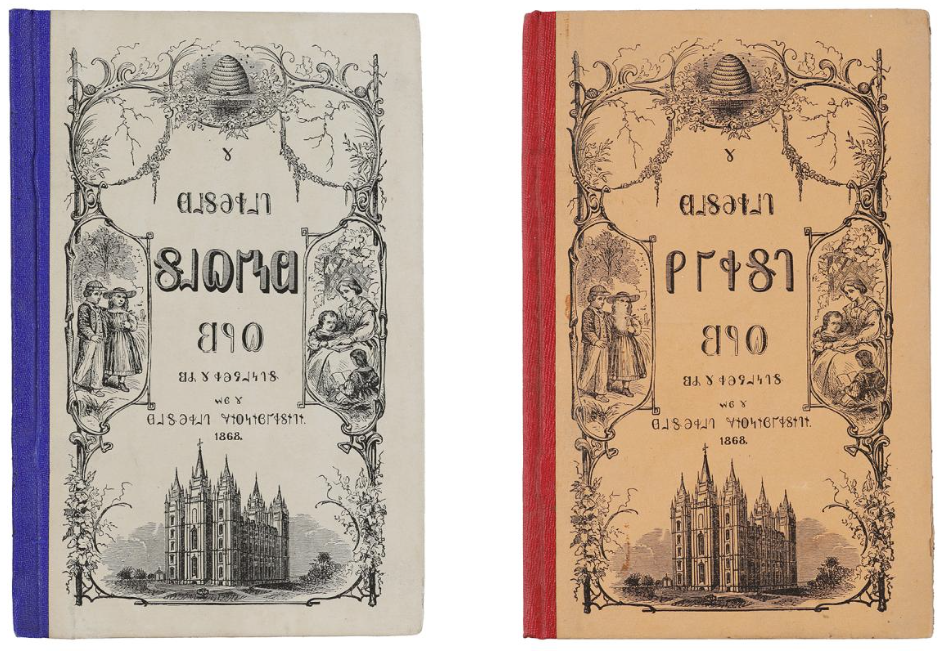
The Deseret alphabet was introduced to the public in 1854. Anyone who knew it could write the language in its cursive form. However, there was an immediate problem with getting books printed. No printer had type in the Deseret alphabet. A foundry was commissioned to build the new type, which was completed in 1858. It didn't catch on, Young blaming the appearance of the type. New type was ordered which was ready in 1868. Now they were prepared for some serious books.
At Young's urging, two school books were printed in runs of 10,000 each in the Deseret language. He understood the importance of learning and the schools in Utah were short of books. The titles were the Deseret First Book and the Deseret Second Book. Of course, those weren't the actual titles (see image above), but since I don't have a Deseret keyboard, I have translated them to the old way of writing.
In 1869, the University Regents authorized the translation of other books to Deseret. The most notable one was the Book of Mormon itself, a lengthy text. Five hundred copies were printed and offered for sale at $2 each. A separate, less expensive excerpt was also printed.
By 1870, Deseret was being taught in schools and night classes at the University of Deseret, now the University of Utah.
From then on, it was all downhill. Printing with these symbols proved very expensive. Meanwhile, acceptance was wanting. For all its difficulties, people were familiar with the old letters. The new letters were harder to recognize. Meanwhile, the railroad opened Utah to more non-Mormon settlement, and these people had little interest in the church's strange letters. All the centuries of written material was inaccessible to people who couldn't read the traditional lettering system. By 1875, even Brigham Young came to realize that the project had been a failure. The University Regents decided to abandon the Deseret alphabet and adopt phonetic spelling with English letters created by Isaac Pittman's brother, Benn. Type was purchased from New York, but by the time it arrived, Brigham Young had died. Phonetic spelling had lost its promoter, and was ignored by Mormon leaders.
The story of the Deseret alphabet is a testament to how difficult it is to get English-speakers to change their traditional weird spelling. Brigham Young is revered and respected by his community like no other, but not even he could convince them to use phonetic spellings.
But... perhaps the younger generation will make some changes. The letter “S” is now frequently changed to “Z” where “Z” better reflects the sound – boyz and dogz. Internet shorthand has created some more phonetic spellings. For example, “ur” for “your,” or “wut” for “what.” “Kool” is better than “cool” which could have a “K” sound but, from spelling alone, might be pronounced “sool.” Whether this will lead to any permanent change rather than just being a temporary fad has yet to be determined. For now, neither Webster nor spell check acknowledge the new spellings.
You can translate English characters to Deseret or vice versa at this website: www.2deseret.com
The J. Willard Marriott Library at the University of Utah currently has a exhibition remembering the history of the Deseret language. You don't have to go to Utah to observe it. They have been kind enough to put the exhibition online. If you like linguistics, history, or just an entertaining story of a failed attempt to make the English language easier to read, you will enjoy seeing it. There are lots of illustrations so you won't have to do too much reading in this difficult language. You can see Designing Deseret, Phonetics and Faith in the American West, at the following link: https://exhibits.lib.utah.edu/s/designing-deseret/page/home