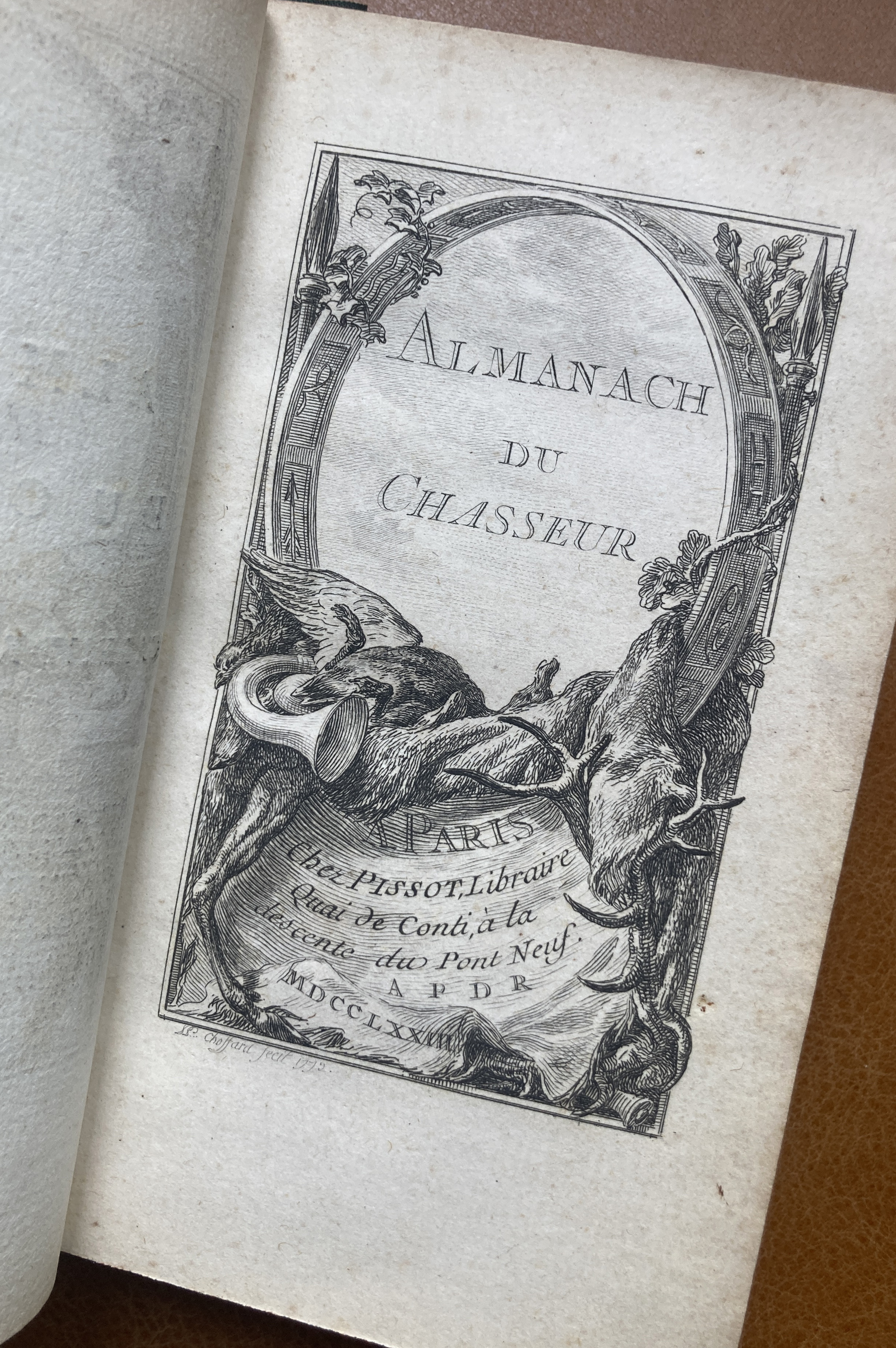
I found this book, Almanach du Chasseur (Paris, 1773) in a book trap—or a book box—near my home. Quite a nice capture, I must say, as it happens to be a hard to find specimen—and much more interesting than expected for a non-hunter.
Finding a 18th century book in the street doesn’t happen everyday, even in France. Three of them got trapped in a book box the other day—these are open boxes where you can leave the books you’re not interested in any more and take any book left by other readers—, which I immediately threw into my “besace” (hunting bag). Among them was the unexpected Almanach du Chasseur, printed (Paris, 1773), a “small and quite rare volume” (Thiébaud) written by Goury de Champgrand. The Rare Book Transaction History shows that a copy was sold for €375 by Alde in 2026 ; that Arenberg Auctions sold one for €1,170 in 2025 and Beaussant Lefevre for €708 the same year. We’re talking here about the first edition (Pissot, 1773), not the 1780 and 1785 reprints that came out under the title of Manuel du Chasseur. Champgrand is also the author of an authoritative book on hunting, Traité de vénerie et de chasses... (Paris, 1776)—a copy is currently for sale at Librairie Ancienne (Paris) for €2,700. A “serious” book, then, that comes with a title page engraved by Choffard ; it represents various dead animals displayed as trophies. Champgrand divided his work into four parts: the almanac itself, an overview of various hunting techniques, a dictionary of hunting terms and hunting musical scores!
Although almanacs are weird to me—I find them quite useless, and consequently consider them with a sort of uneasiness—, I was quite interested in this one. The calendar part is a pretext but the history of division of time is still fascinating—in 1582, Pope Gregory XIII established the Gregorian calendar in order to correct the inaccuracies of the Julian’s calendar: “As it was coming from a Pope, the Protestant states refused to compel—although they knew it was a necessary reform—, and stuck to the Julian calendar instead, thus creating the notions of “old style” and “new style”.”
Then, the various hunting techniques here depicted are quite incredible—there were 100 ways to skin a fox, a wolf, a deer, or a wild boar, and it involves many fields of knowledge (horses, dogs, weapons, music, etc). Hunting actually appears as a language of its own. Hunters used half a dozen words to describe a deer, depending on its age, had various hunting cries depending on the situation: “When you hear a deer jumping, you shout: “watch out, go dog!” When you spot the deer, you shout: “rali-la-ha, perce-la là...” When you actually see the deer, you shout: “tayaux, au tayau...”” And the music scores make it even more complicated. The “Fanfare de la Reine,” for instance, is played “when you hunt a roe deer”; the “Premier ton de chiens” is played “when the dogs are hunting” ; while others seem to be here just for enjoyment.
Hunting was a privilege of wealthy people and Champgrand makes fun of the unfortunate courtesans “who force themselves to attend two or three times a week, and who come back more tired than their horses. Actually, those persons don’t run for animals as much as they run for fortune.” Hunting, he adds, has nothing to do with using bird traps, “which is nothing but petty poaching.”
Another interesting fact about Champgrand is his daughter—Alexandrine-Sophie De Bawr, who was born the year this almanac came out. She’s known for a few plays like Le Rival obligeant (1774), or Les Chevaliers du lion (1804). She was the illegitimate daughter of Madeleine-Virginie Vian, an opera singer, who left for Russia when Alexandrine was only two. “Her father took care of her education,” the Theatre-documention website writes, “and he did very well.” But in 1789, a new type of hunting appeared in France: aristocrats hunting! Now a fair game, Champgrand first lost everything and then fell into an aristocrat trap in 1793—he was imprisoned, and he died 6 years later, “due to the conditions of his imprisonment.” As Voltaire once said, “The elements, the animals or the humans, all is at war / We must face it, evil reigns on Earth.” One day the hunter, the next the prey.
Champgrand’s daughter was then left without any money, but she “was sheltered by André Grétry (a famous music composer); she then wrote musical plays that were interpreted by Garat. They were so successful than she started to earn a living from them.” (Theatre-documentation) In 1801, she married Henri de Saint-Simon, the “future ‘prophet’ of Saint-Simonism’, then a German baron by the name of de Bawr, who died a few years later. “She obtained a pension for life in 1816, from Louis XVIII (...) that eventually made her financially secure.” She died in 1860.
Thibault Ehrengardt