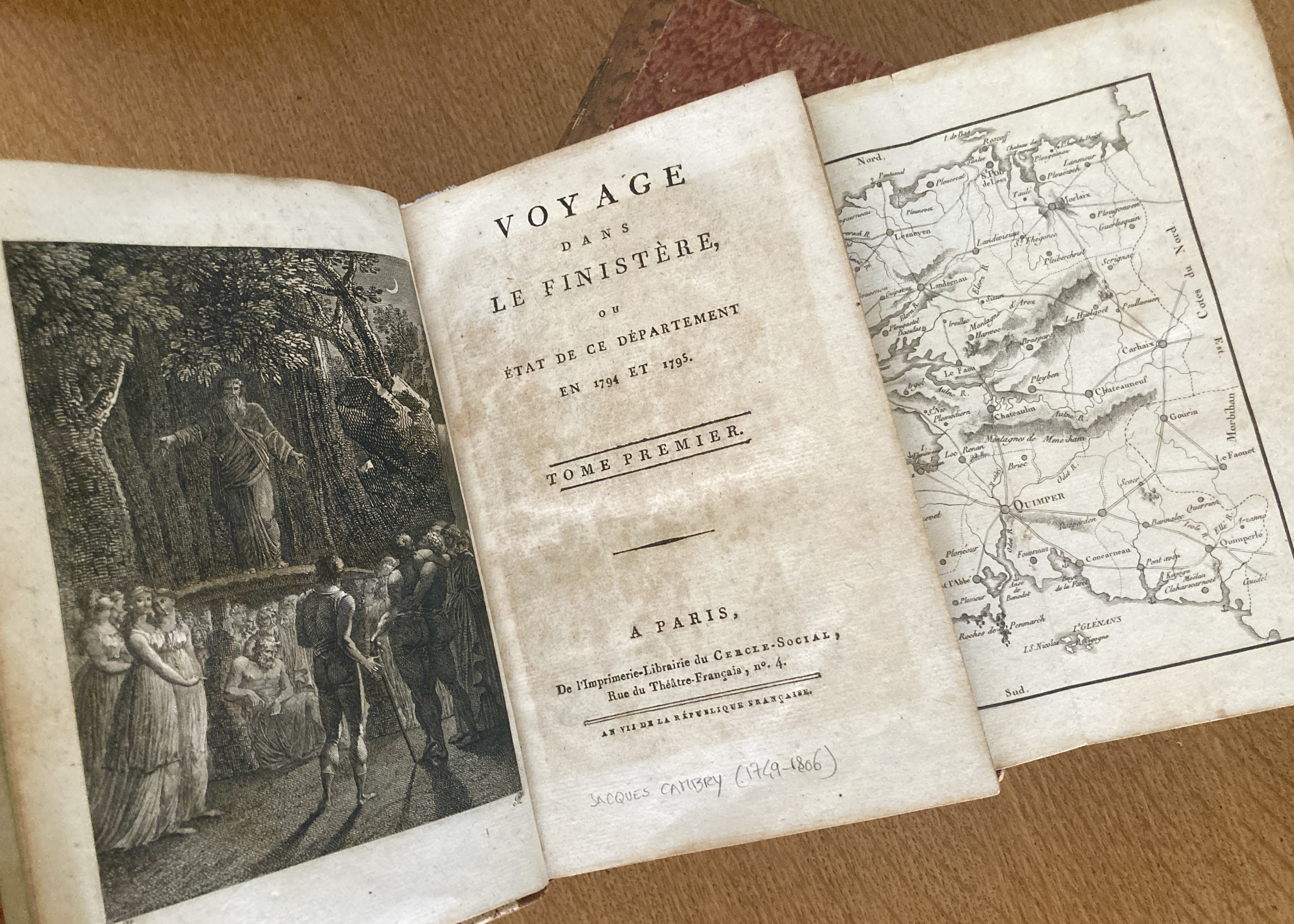
Jacques Cambry (1749-1806) had travelled all over the world before he went to Bretagne, France, in 1794. The relation of this travel happens to be fascinating. What really matters in a travel book is not the travel—it’s the traveller.
CERCLE SOCIAL
Voyage dans le Finistère..., by Jacques Cambry, was printed by the Cercle-Social, one of the weirdest societies bred by the French Révolution. Nicolas de Bonneville (1760-1828)—“one of the most elevated spirits and hearts to be found during the Révolution,” according to Charles Nodier—launched it in 1790. A bourgeois from Evreux, France, Bonnevile was an early revolutionary, who was instrumental in the storming of La Bastille. His Cercle-Social “was neither a political club, nor a Masonic lodge, nor a literary club,” Patrick Brasart writes in Bonneville et le Cercle Social (CAIRN), “but an hybrid creature that was a little bit of all that.” The members of the Cercle met every Friday and published a fiery journal entitled La Bouche de Fer. Bonneville was very close to Thomas Paine, who happened to live at his place between 1797 and 1800—Bonneville’s son later joined the US army and became the main character of Washington Irving’s Adventures of Captain Bonneville (1837).
Involved in politics, Bonneville was once opposed to Robespierre and his fanatics, and narrowly escaped their wrath (Claude Fauchet, another larger than life character, who co-launched the Cercle-Social, was “guillotiné”—beheaded—in 1793). The Cercle-Social also published a few books, including Life of William Penn, and Voyage dans le Finistère. In 1794, the officials of the Finistère (a district of Bretagne) appointed Cambry to conduct a survey of the region, and to visit the warehouses where the goods confiscated from the Nobles and the Church during the Révolution had been stored. Cambry played his part in the Révolution, of course—you wouldn’t expect an author to publish a book at the Cercle-Social by accident.
3 VOLUME SET
Voyage dans le Finistère, ou Etat de ce Département en 1794 et 1795, is a 3-in 8° volume set that first came out in 1799, illustrated with 3 frontispieces, one folding chart, a folding map and 6 full-page engravings drawn by Valentin and engraved by L’Epine. A bookseller will ask around €300 for a good decently bound copy—most copies that you’ll find are bound in half-leather and paper boards, very common bindings for the period. It’s somehow hard to find: according to the Rare Book Transaction History, the latest copy was sold in Belgium in 2024 (Arenberg Auctions) for €169. A beautiful copy was sold in 2017 by Pierre Bergé and Associés in France for €752. I found my copy on eBay.fr—€25 or “best offer”; I like to play, so I offered €21 and got the book! Unfortunately, my copy misses 3 full-page engravings that were never bound. Notwithstanding, I started to read with low expectations, as I’d never exactly intended to read a travel relation to Finistère—l’occasion avait fait le larron, as we say in France (opportunity makes the thief). I was caught off-guard.
BREIZH DA VIKEN—BRETAGNE FOREVER
Bretagne is located in the West end of France. Its inhabitants, the Bretons, occupy a particular place in French history. Once part of the Celtic kingdom, historically torn apart between France and Great Britain, they’ve usually been considered as an uneducated and hard-to-deal-with people. In the late 19th century, the French government decided to unify the various regions of France by banning the use of patois on the whole territory, including Bretagne. In the 1960s, when a child used a “Breton” word (which was usually the language they spoke at home with their relatives), the teacher would wash his mouth with soap! The Bretons are seen as hard-headed people, and they fought hard to maintain their culture alive. Cambry was a Breton himself—a very well educated one. His point of view is thus very interesting, especially at this precise moment, which is the birth of the French Republic. He describes the Bretons as deeply ignorant and superstitious: “Every country has its own follies; our Bretagne has them all,” he writes. “No country is farther from leaving its extravagances behind than Bretagne; the theocratic government of the Druids (Celtic priests), was replaced by the catholic priests’, and the development of the latter’s absurdities has never found a better ground than in those unfortunate creatures. They were kept far from the French who could have helped them; they were carefully deprived all of instruction; and the authorities made sure they’d keep their particular language, so they’d remain in a state of subjugation that was seen as necessary in order to contain their fiery character.” The remark on “their language” is quite surprising nowadays!
Cambry’s love for his country and his people is obvious here, but he was also motivated by his Republican ideals. He addresses all issues, from history to architecture to the development of infrastructures; at the end of the day, his lively, educated, curious and highly incisive spirit makes this travel a fascinating ride! Cambry was a “homme des Lumières”, who shed a unique light on Bretagne indeed, revealing this region to the world and to itself. His book is still regarded as crucial by the modern specialists. And if you don’t like it, or the country here described, or the frequent rains that fall in Bretagne, the Bretons will remind you one of their sayings that goes like ”la pluie, ça ne mouille que les cons —the rain only wets the idiots.” Have a good read.
Thibault Ehrengardt