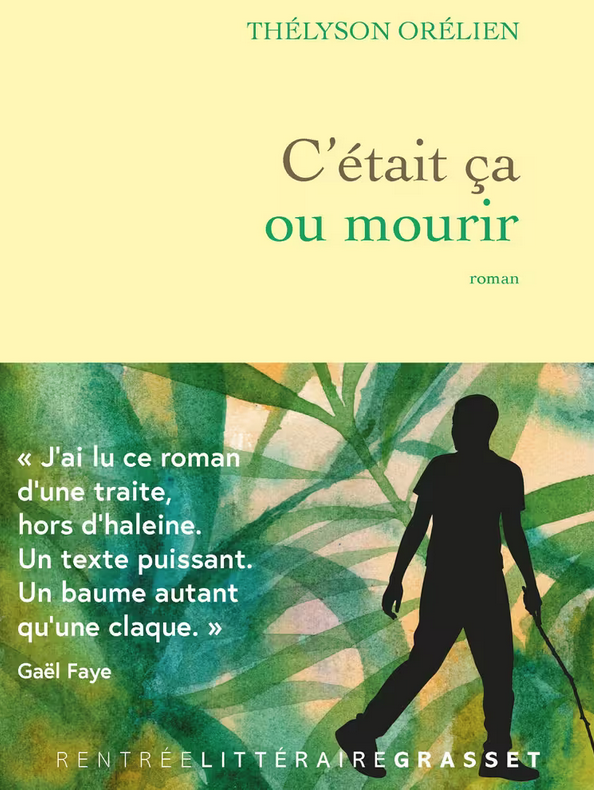
Artificial Intelligence (AI) has opened another Pandora’s box in France—the art of literature is no longer a human privilege. The incriminated novel is entitled C’était ça ou mourir/It Was It Or Death (Grasset, 2026). As a naturally intelligent man once put it: you chose “it” to avoid “death”—now “it” will kill you.
Shame In The Family
On September 21, 2026, a tweet on X claimed that the unexpected success of the literary new season, C’était ça ou mourir by Thélyson Orélien (Grasset) was AI-generated. It became viral as this novel was regarded as the potential next Gouncourt Prize. The tweet came from an anonymous account, “Balance ton Claude” that was used by a group of intellectuals including a French writer by the name of Samuel Fitoussi. According to Fitoussi, the AI detector Pangram was positive: Orélien’s book didn’t come from a human brain. Many critics had already enjoyed and publicly praised it, so they felt betrayed—by a trickster, yes; but most of all by their own emotions. AI has the power to move them as much as a human being, and that’s a fact. Well, it also proved that partiality isn’t always a good adviser. Indeed, there was also a political dimension to it.
Burnin’ All Illusions Tonight
A few days later, some writers and critics gathered on the “C ce soir” TV show to discuss the matter. Virginie Despentes, a genuine (punk) writer was uneasy and struggled to find an acceptable position—she’d enjoyed Orélien’s book. She didn’t suspect it to be AI generated, and now it was too late to deny her emotions. Should we suspect every writer to use AI? she asked—well... She also curiously blamed another guest: using AI in literature wasn’t an issue, she said—well... The relevancy of AI detectors was questioned after one of them labelled a poem by Victor Hugo as AI-generated. And then there was this other guest, who unearthed the political issue. Orélien, she said, is a black Canadian-Haitian writer, who wrote about his experience as an illegal immigrant. Here is why he was the victim of this insulting fake news. This attack, she suggested, was fishy!
France is on the edge of chaos right now. The next elections are coming after ten years of crisis and disillusion, and many fear that we’ll have to choose between the far right and the far left. Every event is interpreted through everyone’s own intellectual “algorithm”. As Orélien’s book relates his struggle after he fled Haiti for Canada, the Leftists used it to tackle the far-right anti-immigration position. Orélien was the living proof that illegal immigrants had a lot to offer, and that they should be embraced and not pushed away. Publishers, intellectuals, journalists and writers all came together to praise the book— there are many Leftists in the book business, for obvious reasons. They had no words to express their admiration. Orélien was compared to “Victor Hugo”, called a poet and one intellectual went as far as saying that every sentence of his book was an aphorism! The book was indeed on its way to winning the Goncourt Prize—the Leftists had their champion, especially since he kept denying using AI.
The publication Livres Hedbo gave the first blow, clearly proving that Orélien had plagiarized various works all through his career! “Orélien denies using the AI for his novel but admits plagiarizing other texts in the past,” Radio France wrote on October 13. Orélien apologized for stealing others’ works but maintained AI wasn’t involved in his novel. The scandal didn’t stop the book from selling, but it was retrieved from the official list of the Gouncourt Prize. The Leftists cried prejudicial foul!
Finally, on October 22, Orélien’s publisher Boréal publicly announced that following some thorough researches, they were now convinced that their author had used AI to write his book, and that they were putting an end to their collaboration with him. Orélien confessed shortly afterwards, saying he had been overwhelmed and didn’t know how to react. The Leftists’ champion was a nag.
The Book Is Dead
This story also acknowledges a new reality: AI has taken over literature. We thought the machines would be good at calculations but terrible at arts. They are good at both, and it won’t be long before we can’t make the difference—and then, the day will come (soon) when we won’t even care. AI is already a component of the creative process, and one day it will become the full creative process. Despentes is right to worry—she has already lost the battle; we have already lost the battle. Moral ethics have become irrelevant in arts. As long as emotions are generated, it’s all right. The amount of what has been written so far is enough to generate new writings forever—in this matter, it seems that we won’t need ourselves any more.
What happened with Orélien’s book is another chapter in the agony of the book. This sacred object that has kept and spread our knowledge and identities for so many centuries has been replaced by screens and data centres. That’s where you need to dig nowadays, if you want to access human knowledge—not into a library. I’ll always remember this not so well educated guy laughing at me with contempt when I told him I was writing a book. “A book?! Who needs that, when you have this?” And he showed me his mobile phone. I was sorry for him, but I don’t know who will laugh last.
The rise of IA means the death of a pillar of our civilization, the book; at least as we define it since the days of Homer. Its agony will be long and it will fight back—it still holds huge power! Yet, it’s already received the deadly wound, and unless a worldwide shutdown “saves” us from this new turn of things, there’s not much we can do. We’ve created a monster with the help of technology—now we need to embrace it, even to love it, or else it will destroy us. It was all written in an old book by Mary Shelley. If you don’t know which book I’m referring to, ask ChatGPT.
T. Ehrengardt