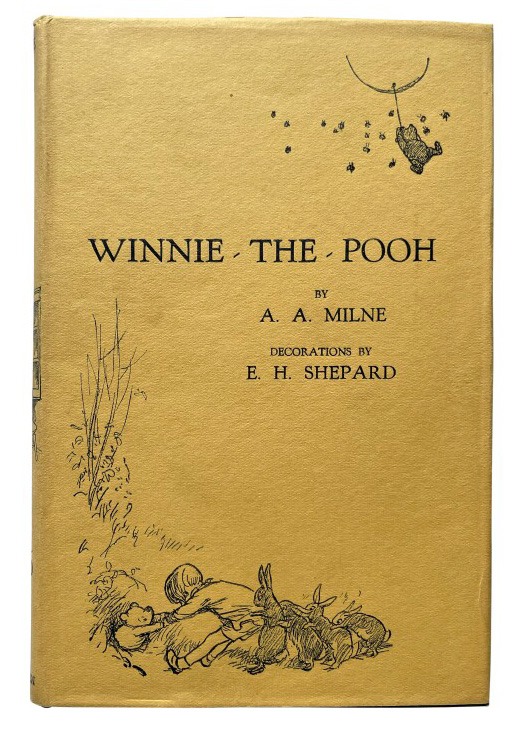
Oct. 14, 2026 marked the 100th anniversary of the childhood classic Winnie-the-Pooh and everyone from the Guardian, Washington Post and New York Public Library weighed in for the occasion. Notwithstanding a sea of congratulatory press, if you’re in the rare book world there’s still a lot to know about this “silly old bear,” his publication history and the many twists and turns along the way.
The Bookish Part
Winnie-the-Pooh was the second of four volumes, all written by A.A. Milne and illustrated by E.H. Shepard and published by Methuen in the UK and E.P. Dutton (now Penguin Random House) in the US. Since they were first issued they have never been out of print.
They are in chronological order:
- When We Were Very Young, Nov. 6, 1924
- Winnie-the-Pooh, Oct. 14, 1926
- Now We Are Six, Sept. 15, 1927
- The House at Pooh Corners, Oct. 11, 1928
The two Pooh books are collections of short fanciful adventures of the honey-loving bear and his friends in the Hundred Acre Woods, while the other two are whimsical verse for the very young in which Pooh makes cameo appearances.
A short informative video narrated by Pom Harrington of the noted London bookselling firm Peter Harrington is a quick and painless way to see all four volumes and their dust jackets, bindings and other points of issue for the UK first editions. https://www.youtube.com/watch?v=yUvCMdi7fFE
Pooh first shows up in book form as a poem called Teddy Bear in When We Were Very Young; At that time he was named Mr. Edward Bear who worries about growing “tubby without exercise.” The rhyme was published earlier in Punch magazine as Edward Bear on Feb. 13, 1924. Later, in Now We Are Six, he is featured in 11 of its 35 verses.
Some estimates put the cumulative total printings of the four US & UK titles at 50+ million including special editions. When the books were first released in the 1920s, they were instant hits. For instance, Winnie-the-Pooh (1926) sold roughly 35,000 copies in the UK and over 150,000 copies in the US within just a few months of issue and has been going strong ever since.
Pooh has reportedly been translated into 70+ languages and even more dialects. A Latin version Winnie-Ille-Pu was published in Brazil in 1958. It went on to appear on the NY Times best seller list in 1960, where it stayed for 20 weeks, the only foreign-language and Latin book to ever make the list.
In terms of literary worth the verdict seems to be unanimously positive.
As for monetary value the results vary widely. There are recent Rare Book Hub records for both the London and New York first editions.
All four of the UK volumes (three of them with dust jackets) turned up at Gorringes in Sept. 2026 where they sold for £22,100, well above the presale high estimate of £1,500. That was a high spot.

These are the four UK firsts (Methuen - 1926) that sold at Gorringes in Sept 2026. Aall but one had its original dust jacket. The lot went for £22,100.
More typically, just the 1926 Pooh book alone in a UK first might go from less than $1,000 to several thousand, depending on condition, binding and the presence of the original dust jacket. There is a significant number of 2025 and 2026 records for the London edition, often in lots with one or more of the other titles.
Surprisingly there are fewer records for the 1926 US edition. In 2025 a very nice American (Dutton) first with a dust jacket signed by both Milne and Shepard sold at Bonhams on Dec. 18, 2025 for $8,320, but most of the other prices were well below this mark, both in price and condition.

This is the copy of a US first (Dutton 1926) that sold at Bonhams in December 2025 for $8,320. It had a dust jacket and was signed by both Milne and Shepard.
Both author Milne and illustrator Shephard were quite well known in their day: Milne as a playwright and Shepard as an artist. Both were associated and published in Punch before their Pooh collaboration and both became wealthy men as a result of their association with the small-brained stuffed bear.
By all accounts the fame and money made them unhappy. Milne longed for recognition for his other work, especially his plays and felt pigeon-holed by the success of Pooh. He also felt guilt over how Pooh’s massive popular success affected his son, Christopher Robin, who was namesake and to a certain extent a model for the boy in the stories. Shepard ended up resentful that his other artistic efforts were ignored and reputedly regretted he had ever agreed to the assignment that made him a star illustrator in the literary world.

The author’s son, Christopher Robin Milne, was the inspiration for the character of the same name in the book. He is shown here with his toy bear in the mid 1920s. The real Christopher Robin was a famous child in his day, and while at first he enjoyed the attention he later came to feel it was a burden and he blamed his father for making him a celebrity and invading his privacy.
The impact of fame on the real Christopher Robin Milne has been well documented both in his own memoirs and in the somewhat fictionalized motion picture Good-Bye Christopher Robin (2017). As one of the most recognized and well-publicized real-life children of the 1920s, he initially enjoyed his youthful fame. Later at school he was bullied and teased about it and came to resent how celebrity intruded on his privacy; he blamed his father for putting him in the spotlight. The younger Milne wrote a series of biographical books including The Enchanted Places (1974) followed by The Path Through the Trees (1979) and later the Hollow on the Hill (1982). He ended up in Devon running a bookstore with his wife Lesley.
Enter Disney and the Merch
In 1930 licensing rights were sold to Stephen Slesinger for $1,000 and a share of the royalties. Decades later in 1961 Slesinger and the Milne estate sold them to Disney on a royalty basis. The bear first appeared as a Disney character in a 1966 animated feature Winnie-the-Pooh and the Honey Tree. In 2001 Disney made a final buyout of rights and royalty payments said to be $350 million.
Over their lifetime as animated Disney characters Pooh and friends have become some of the most popular Disney characters and reportedly made from $50 billion to $76 billion. Most of the revenue from Disney’s Pooh comes from related merchandise with estimates ranging from $3 to $4 billion per year at its peak. Winnie-the-Pooh is considered among the top animated fictional characters, right up there with Mickey Mouse and Bugs Bunny.
And don’t forget the political overtones:
The Disney pudgy red shirted cartoon character first created political waves in 2013 when internet memes showing Chinese President Xi Jinping walking alongside a taller slimmer, dare we say, bouncier U.S. President Barack Obama. The internet exploded with snarky comments comparing the picture of the two to Winnie-the-Pooh walking with Tigger. The Powers-That-Be were not amused.

The photo that set off the comparison in 2013 and raised a political ruckus. The Chinese were not amused.
In 2014 the subject of ridicule came up again. The comparison originated from a photo showing a stiff, gloomy-looking handshake between Japanese Prime Minister Shinzo Abe and Chinese President Xi Jinping during an APEC summit in Beijing. Online users paired the photo with an illustration of Winnie-the-Pooh and Eeyore, the chronically depressed donkey.

Eeyore and Pooh were compared to Japanese Prime Minister Shinzo Abe and Chinese President Xi Jinping in 2014. The authorities didn’t think it was funny.
Once again it sparked a wave of satirical memes that irritated Chinese authorities. In July 2017 the internet crackdown tightened ahead of a major party congress. Later in 2018 the live-action Disney film Christopher Robin was entirely banned. Since then Chinese platforms (such as Weibo and WeChat) have bans on name mentions, images, and stickers referencing Winnie-the-Pooh when used in satirical or political contexts.
The Chinese censorship appears aimed more broadly at anything making fun of those in power and any challenge direct or indirect to China’s political leadership. Some physical and official Pooh merchandise, including products sold at the Shanghai Disney resort, are still permitted.
And the merch goes on:
For book people, especially older book people, Winnie’s 100th birthday is a sentimental occasion and a moment to look back on more gentle and innocent times when thinking up silly hums or walking around in circles in the snow was considered a day well spent.
But for the world at large Winnie-the-Pooh’s centenary is seen as a golden opportunity to cash in on the fame and enduring charm of the characters Milne created a century ago. A few current

A 4 inch tall mini Steiff Centennial Winnie dressed as a bee is offered in a limited edition with a selling price of $160
examples include a $160 Steiff stuffed bear dressed as a bee or a $40 Pooh Hunny Pot travel mug. There are plushies of every size and description, clothing, pajamas, Halloween costumes and backpacks.
As for the centennial books, trust your friends at Rare Book Hub, the results are “meh” or worse. What’s offered is tricked up, gilt edged, ribbon bookmarked single volumes or not too impressive boxed sets. These books are issued without dust jackets and available at such well known booksellers as Target.
If you’re still in the market for Pooh skip the not too impressive commemorative editions and shop for an actual vintage copy. There are plenty around with genuine charm and the original illustrations that have been loved for generations. There’s lots to choose from and many aren’t expensive. If you’re young, or young at heart they’re all still good reads.
Here are links to a few of the birthday articles and celebrations:
The People story advises there really was a live Canadian bear named “Winnie” https://people.com/winnie-the-pooh-turns-100-the-surprising-history-you-didnt-know-about-the-popular-cartoon-12173138
The Guardian slips in a mention of another British bear name “Paddington”
At the BBC a time capsule is buried at a tea room in East Sussex to mark the occasion
https://www.bbc.com/news/articles/ckjwevwvqj8vo
The Washington Post notes Britain wants its bear back
The NY Times notices “if you are extremely rich you can have exactly what you want.”
https://www.nytimes.com/2024/11/07/books/review/winnie-the-pooh-when-we-were-very-young.html
While the NY Public Library is party central for the American celebration
https://www.nypl.org/spotlight/winnie-the-pooh-100

An original sketch of Pooh and Piglet by EH Shepard done
in the 1930s as part of a letter.
Reach RBH writer Susan Halas at wailukusue@gmail.com