


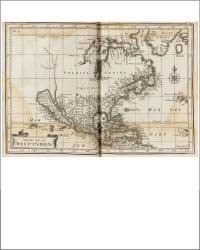
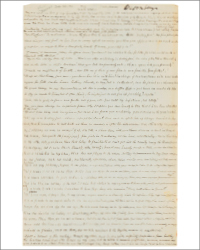
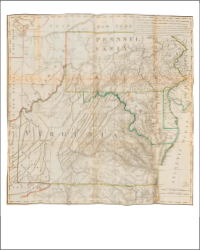
David M. Lesser Fine Antiquarian Books has released their Catalogue 214 of Rare Americana. Lesser regularly issues catalogues of material related to historical American events and people. They are largely pamphlets, broadsides, documents, letters, and ephemeral items not meant to last for a long time. These have. Here are a few selections.
We start with a sensational item, the Horrible Murder of Mrs. Ellen Lynch, and Her Sister Hannah Shaw...with the Trial and Conviction of Arthur Spring. Note: Some sources have Shaw's first name as Honora rather than Hannah. On the night of March 10, 1853, the sisters were brutally murdered. Shaw's husband had gone to California to find gold and was presumed dead. Lynch's husband was away on business. Along with the bodies and much blood was found the tip of a knife that had been used to pry open Mrs. Lynch's trunk. Since she was found in her night clothes, it was assumed she knew the killer or she would not have let him in. Suspicion quickly fell on Arthur Spring, a frequent visitor. A blood stain on his shirt gave him away. Spring and his son, Arthur Jr., were arrested for murder the following day. Arthur, Jr., quickly named his father as the killer, saying he had confessed to the crime the previous night. Arthur, Sr., placed the blame on his son, but the son's version is the one authorities believed. A trial was held March 21 and within two weeks of the murder, Arthur, Sr. was convicted. An issue with a juror forced a retrial, held on April 4, and once again, Spring, Sr., was convicted. Justice was swift in those days. On June 10, Spring was hanged. He proclaimed his innocence to the end but also said his son was innocent. Item 93. Priced at $450.
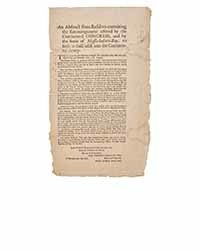
Two centuries ago, the British and the French were constantly fighting each other over one thing or the other. Occasionally, America would get caught in the middle. In 1799, the French were also angry with the United States. They put out an “arrette” (order) that any American seamen found on board ships of the enemy were to be treated as pirates. This was ironic considering the British were impressing American seamen against their will into service for their Navy and the French might in turn treat these innocent men as pirates. Item 3 is John Adams' Message from the President of the United States Communicating to the House such Information as He has received Touching the Suspension of the Arrette of the French Republic... Adams informs Congress that the Arrette applies only to American seamen. He transmitted a letter from Lord Grenville to the American Minister at London that should such an order be enforced that the British would retaliate against any French prisoners currently under their control. At least the French weren't giving kill orders against American seamen. Item 3. $275.
At the founding of America, slavery was permitted. The founders morally disliked the institution but believed it was an economic necessity, and that it would fade away in a number of years. A few decades later, the northern states had abolished it but the South dug in its heals. Even gradual emancipation was rejected. That forced its supporters to try to claim it was something good rather than the evil it was. William Harper, a high ranking judge, was one such person, and his arguments for it are sickening. This is his Memoir on Slavery, Read Before The Society for The Advancement of Learning, of South Carolina, at Its Annual Meeting at Columbia. 1837, published in 1838. He claims slavery is “a principal cause of civilization,” indeed “the sole cause...He who has obtained the command of another's labour, first begins to accumulate and provide for the future, and the foundations of civilization are laid.” He says this is the truth “with no exceptions whatsover.” It is slavery that raises man from being a “biped brute.” If this wasn't enough, Harper justifies the use of slave women for sex by the masters as being better for his reputation than alternatives. He says, such “licentious intercourse” between master and slave woman “is less depraving in its effects, than when it is carried on with females of their own caste...The intercourse is generally casual; he does not make her habitually an associate, and is less likely to receive any taint from her habits and manners.” Slavery did not raise this piece of moral trash from being a “biped brute.” Item 55. $1,500.
In case you've forgotten the meaning of “apotheosis,” as I did, it refers to a high point, in this case a relationship. This is a carte de visite created sometime shortly after the assassination of Lincoln by someone who obviously admired the late President. The image depicts Washington and Lincoln in the clouds of heaven. Washington wraps a hand on Lincoln's shoulder while the other holds a halo over his head. Lincoln has one arm around Washington. It is a somewhat strange image but there's no doubt how the artist felt about Lincoln. Item 65. $275

Here is sad story published c 1865, The Lamentable History of the Beautiful and Accomplished Charlotte Temple, with an Account of Her Elopement with Lieutenant Montroville, and Her Misfortunes and Painful Sufferings, are Herein Pathetically Depicted. The book was originally published under the title Charlotte Temple a Tale of Truth. True it was not. This story is pure fiction. Nonetheless, it was a huge bestseller, for years the bestselling book in America. Pathetic tales are popular with readers. This one gave way to pulp and dime novels that would become what Americans would devour for many years. In this story, 15-year-old Charlotte Temple falls for a British officer in 18th century New York. She believes Montraville will marry her, but after getting Charlotte pregnant, he disappears. It's all downhill from there. She has her baby, but they live in poverty. Her father agrees to take her back, but she becomes ill and dies before making it home. Item 87. $875.
This is an amazing document from Confederate Vice President Alexander Stephens, written before the war but published during the Civil War. Stephens warns in no uncertain words of the calamity that will befall Georgia if they agree to secede. Once they secede, he warns, that is a decision that “can never be recalled; and all the baneful consequences that must follow, will rest on the Convention for all coming time. When we and our posterity shall see our lovely South desolated by the demon of war, which this act of yours will inevitably invite and call forth... who but he that shall give his vote for this unwise and ill-timed measure shall be held to strict account for this suicidal act by the present generation, and probably cursed and execrated by posterity in all coming time, for the wide and desolating ruin that will inevitably follow this act you now propose to perpetrate?” Strong words but prescient. The only problem is that this version of Stephens was as fictional as Charlotte Temple. He never said such words. It was all a fake. Stephens at first opposed secession, but when Georgia decided to secede, he supported their decision. Stephens later repudiated the claim. Item 94. $750.
David M. Lesser Fine Antiquarian Books may be reached at 203-389-8111 or dmlesser@lesserbooks.com. Their website is www.lesserbooks.com.