
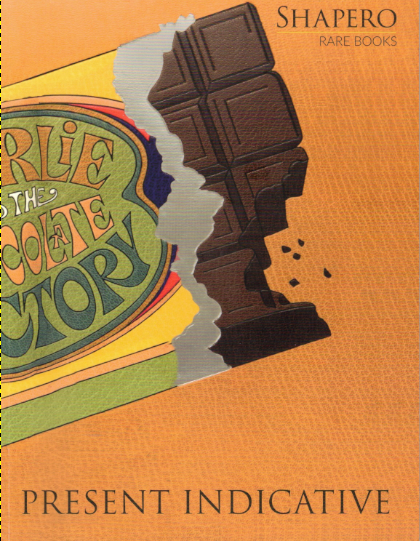
Shapero Rare Books has issued a new catalogue titled Present Indicative. I'm not sure at present what this title is indicative of, but I can say the books are an excellent assortment. It is broken down into sections since there is a wide variety of material. They are: Fiction, Poetry & Prose, Children's & Illustrated, Visual & Performing Arts, Modern Prints, Hebraica & Judaica, Near East & Islamic, and Special Interest. There are 146 items altogether. These are a few samples.
We begin with a book for people who love cats, or at least, have learned to live with them. They can be quite demanding. T.S. Eliot wrote a book of poems about them, Old Possum's Book of Practical Cats. “Old Possum” was Eliot's nickname. Eliot owned cats and was fond of them, though, with all their scratching and jumping, they can turn your home into a wasteland. Perhaps they were his inspiration. This was not a particularly well-known work until 1981 when Andrew Lloyd Webber turned this book into the hit musical play Cats. Published in 1939. Priced at £975 (British pounds, or approximately $1,303 U.S. dollars).
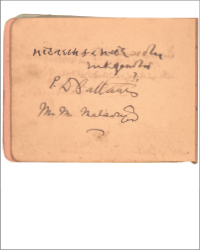
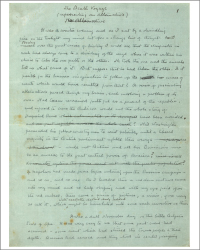
People weren't talking about climate change in 1962, but one writer was anticipating its effects in this science fiction book, The Drowned World. In this book by J. G. Ballard, intense solar radiation has warmed the earth's surface. Sea levels have risen from melting ice caps, resulting in much of the earth's surface slipping under water. People have migrated to the North and South Poles where temperatures are still inhabitable though more like the tropics today. The book concerns an expedition back to London by scientists surveying life in the lagoon that now covers the city. One difference between Ballard's scenario and what is happening today is that for Ballard, it was natural events relating to solar radiation rather than actions by humans that was responsible for the catastrophe. Item 2. £1,375 (US $1,838).
One of the most discarded books is the encyclopedia. They get outdated quickly by later editions. No one wants them, unless they hang around long enough to become very old. Then they become collectible historic references. Item 118 is such a set. It's the third edition of the Encyclopedia Britannica, published 1797-1801. The first edition was much smaller, only three volumes. This begins editions that are more like what we see today. It contains 22 volumes including 2 supplementary volumes. There are 592 engraved plates and maps. Item 118. £7,500 (US $10,025).
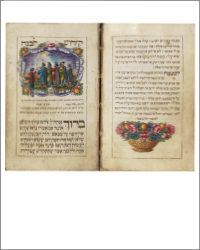
This is an interesting, touching, in many ways beautiful book with an absolutely horrific background. The title is Di Farshvundene Velt (The Vanished World). The German language and date of publication, 1947, hints at the horror. The vanished world is that of Eastern European Jewry of the 1920s and 1930s. That world, and the lives of most of its people, died in the Nazi Holocaust. Raphael Abramovitch sought to preserve that world, at least in terms of images, before most was forgotten. Abramovitch was a Russian, a socialist but not a Bolshevik. He almost lost his life after his side lost out to Lenin's faction, escaping to Germany in 1920. He published a socialist newspaper in Germany, but being a Jew, he once again found himself in a dangerous place after the rise of the Nazis. He fled to France, only to find the danger return after Germany invaded France. In 1940, he was on the move again, this time to New York. To preserve this history of pre-war Eastern European Jewry, Abramovitch solicited family photographs and postcards from readers of the Yiddish language Daily Forward. He received thousands of them. He also had access to old photos that had appeared in earlier editions of the Forward. Abramovitch selected those pictures he felt best represented these vanished communities. He is listed as the editor of this photobook. Captions are provided in English and Yiddish. This is the first and only edition of what Shapero calls a work “that has never been superseded.” Item 93. £875 (US $1,171).
Bill Brandt was German, but his father was English. In 1931, he went to London to learn more about his father's native land. He brought a camera with him. From then until 1935, he roamed around the country snapping photographs. However, he was not a typical tourist. It's not clear how Brandt saw himself but others have regarded him more as an anthropologist. He took pictures of all sorts of places and the “natives.” He photographed the cities and the countryside, the rich and the poor and those in between. The pictures displayed the economic disparity between the English people and the conflicts behind the genteel images of the British. Brandt's timing was perfect. In the first half of the 1930s, there was still peace, Germany was no threat to England. He could have visited all over the country unimpeded. He could not have known that five years later, the two countries would be at war with Britain fighting for its very survival. Item 77. £1,200 (US $1,605).
Shapero Rare Books may be reached at +44 (0)20 7493 0876 or rarebooks@shapero.com. Their website is www.shapero.com.