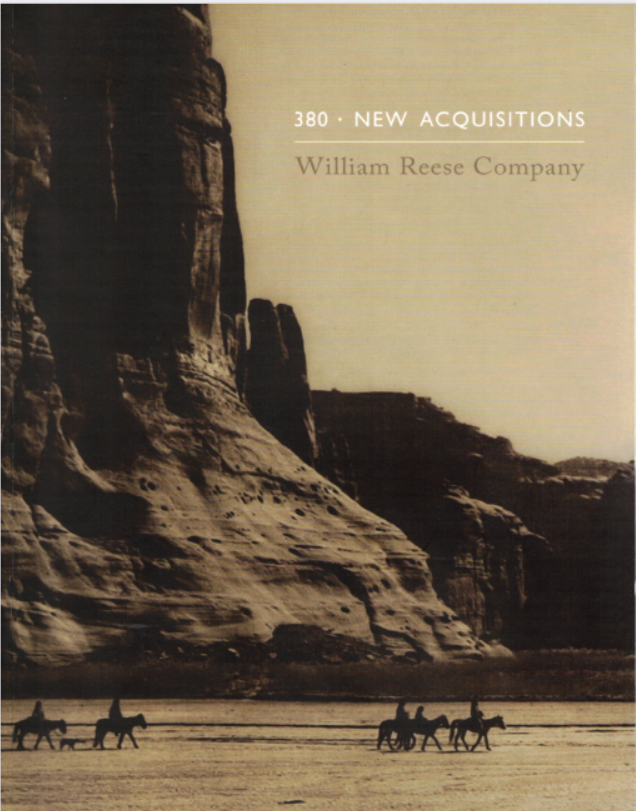
The William Reese Company has issued a catalogue of New Acquisitions. It is catalogue #380 in their long-running series. Their focus is on Americana, and there is much of historic significance in this field to be found here. From colonial times, to the Revolution, growth, disintegration into civil war, Reconstruction and opening of the West, it is all here in contemporary accounts. Reese offers a fantastic selection for those interested in early American history. These are a few of the items offered.
We begin with a copy of the Pennsylvania Evening Post dated July 13, 1776. The Post had been the first newspaper to announce independence and the first to print the Declaration of Independence, a week prior to this issue. This edition reports on the reading of the Declaration of Independence to each brigade of the Continental army and the razing of the statue of King George. It says the reading of the Declaration was “received with loud huzzas, and utmost demonstrations of joy.” Does anyone say “huzzah” anymore? It continues that “...the equestrian statue of George III which Tory pride and folly raised in the year 1770 was, by the sons of freedom, laid prostrate in the dirt, the just desert of an ungrateful tyrant!” Item 4. Priced at $9,500.
This is a letter written by John Quincy Adams, long before he, nor even his father, became President. It was written to William Cranch on December 8, 1787. Cranch was a cousin of Adams who later served as a federal judge. Adams is opposed to the Constitution as then written as not sufficiently protecting the rights of the people. Adams writes, “...I am still of the opinion that if this constitution is adopted, we shall go the way of all the world: we shall in short time slide into an aspiring autocracy, and finally tumble into an absolute monarchy, or else split into twenty separate and distinct nations perpetually at war with one another, which God forbid.” Adams' fears would largely be alleviated later with the addition of the Bill of Rights. Item 3. $95,000.
Here is another American Constitution, though you may not recognize its location. It is the Constitution of the State of Jefferson. Where is that? It was a proposed state, which at the time (1859) was located in the western part of the then much larger Kansas Territory. As the Gold Rush brought prospectors to the Rocky Mountains, the area's interests decoupled from those of the Kansas flatlands to the east. That led to a proposal to break off the western part of Kansas, with the original name proposed to be “Jefferson.” A parallel government coexisted with that of the U.S. in Jefferson for fifteen months before Congress authorized the addition of a new state along the Rockies. However, it was not named Jefferson. The state, covering virtually the same area as Jefferson, was named “Colorado.” The Jefferson constitution is printed here in the the Rocky Mountain News. Item 20 includes the editions of August 20 and October 20, 1859. The first issue of the Rocky Mountain News on April 23, 1859, was the first item printed in what is now Colorado. The News survived almost 150 years before shutting down in 2009, a victim of the change in reading habits from newspapers to websites, that destroyed many other newspapers. Item 20. $27,500.
Unusual people were once a major sideshow attraction. In those days, it was more acceptable to stare at people who were different. Item 9 is a collection of cartes-de-visite of various such performers, many managed by P. T. Barnum. They include the famed Siamese twins Change and Eng, conjoined former slaves Billie and Christine McCoy, Tom Thumb and Commodore Nutt, a couple of bearded ladies, the Wild Men of Borneo (who were neither wild nor from Borneo, but were a couple of very small, slow-witted men from Ohio), a family of albinos, Barnum himself, and a few otherwise notable people such as Edgar Allen Poe. Item 9. $7,500.
Military drafts are never particularly welcome, considering that all who want to serve have an opportunity to volunteer first. The troop demands of the Civil War necessitated President Lincoln to resorting to the draft. New York City was a place where the draft was particularly unwelcome, resulting in race riots in July, 1863, where recent white immigrants took out their frustrations on black people. That didn't stop Lincoln, who came back in August with another demand for men to serve in the army. Item 47 is a partly printed document signed on August 10, 1863, by Abraham Lincoln. It calls for 2,050 troops to be furnished from the 2nd Congressional District of New York, which covered parts of New York City and Long Island. $60,000.
You can reach the William Reese Company at 212-641-0199 or amorder@reeseco.com. Their website is found at WilliamReeseCompany.com.