


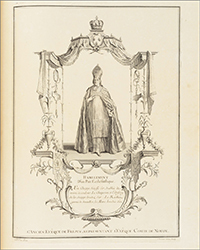
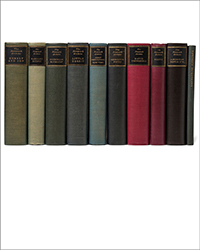
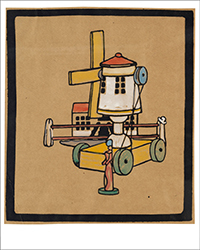
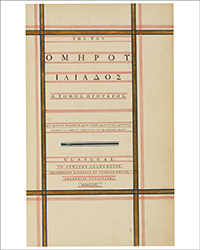
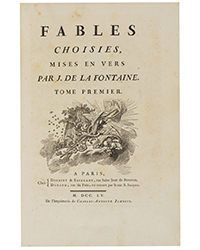

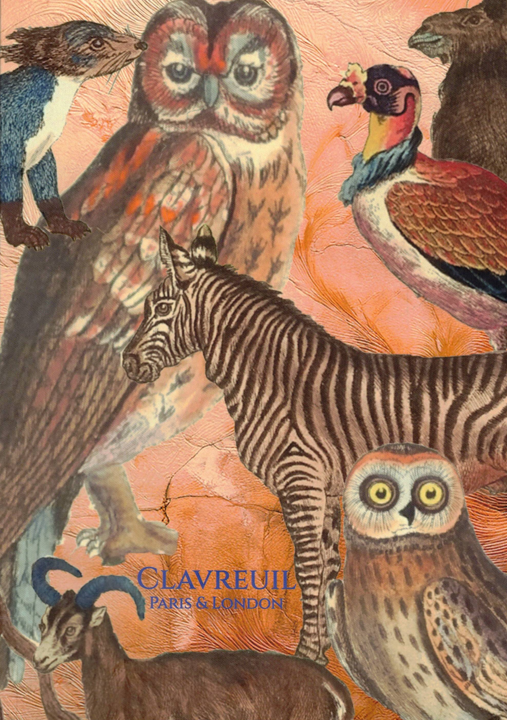
Clavreuil, of Paris and London, has released a new catalogue of Cent Livres du 15eme au 20eme Siecle, Eté 2026. That translates to "100 Books from the 15th to the 20th century, Summer 2026." Most of the books were written in the French language, even those which began with different origins. This group includes numerous American books and others originally written in English, translated to French. We will mention some of these. Others are strictly French, but often works of great importance. Here are a few samples of what we found in the new Clavreuil catalogue.
We will begin with a book that is all about America, but was written by a French writer. He wrote it in English. This is the first French edition, translated (by the author) to his native tongue. That's a bit confusing. The writer was Michel Guillaume Jean de Crèvecoeur, who anglicized his name for English language editions to John Hector St. John de Crèvecoeur. The title is Lettres d’un Cultivateur Américain, or in the English edition, Letters from an American Farmer. The French edition was published in 1784, but the original was published in 1782, during, but close to the end of the American Revolution. These letters are presented as the work of a Pennsylvania farmer, though in reality, Crèvecoeur was a writer who faked them. However, he did purchase a farm in upstate New York, so he wasn't totally ignorant of his claimed avocation. Written for a Europeans audience, he tells all about America, Americans, their habits, views, values, etc. For many Europeans, this was the only real look at America they had ever seen. Crèvecoeur used different letters in different editions, his views on Americans somewhat tailored to what he believed his audience wanted to hear. While he found faults with Americans, he was mostly positive, being impressed with the kind of nation these people were building, even if they personally were quite imperfect. He praised America's willingness to accept immigrants from all sorts of different backgrounds. That was unusual in his time (and ours). The one thing he abhorred about America was slavery. He witnessed the brutality of the slaves' treatment, leading his "farmer" to condemn man's brutality towards other men. Item 28. Priced at 12,000 €.
The next book is about a Frenchman who was a great American hero. It was written by an American President. The Marquis de Lafayette was from a wealthy French family, but early in life became enthralled by the American Revolution. He saw it as a noble cause and wished to help. He came to America and served as a low level soldier. He then returned to France to drum up support for the American revolutionaries. He was quite successful, and when he returned to America, he became a high level figure in the military. He led troops during the Battle of Yorktown, the successful final battle of the Revolution. He was an admired person in America, revered by all from George Washington down to the average citizen. They wanted him to stay, but he returned to his homeland to promote their Revolution. That too was successful, but what followed that success was terrible beyond Lafayette and most people's imagination. He would later become a politician in France, representing liberal causes until the end of his life in 1834. In 1824, he returned for America's 50th birthday celebration and a lengthy tour of America, visiting all 24 states, warmly welcomed everywhere for his contributions to American independence and freedom. On December 31, 1934, (former) President John Quincy Adams delivered a speech honoring America's French hero. Lafayette had died earlier that year. Item 2 is Oration on the Life and Character of Gilbert Motier de Lafayette, by John Quincy Adams, published in 1835. Item 2. 2,800 €.
This next item is one of the greatest if not the greatest scientific book ever written. It made us look at ourselves in ways never before imagined. It was originally published in English, but it was of such importance as to deserve to be translated into every language so that all could understand. The title is De l’origine des espèces ou des lois du progrès chez les êtres organisés. It is commonly known in English as On the Origin of Species. This French edition was published in 1862, following the first in English in 1859. The book itself needs no introduction. This edition includes the lengthy preface by the translator, Clémence-Auguste Royer, who also made some textual changes. None of this was approved by Darwin, and while he thought she was clever, he was not comfortable with some of the changes. For Royer, what she did gave her a notable reputation in French scientific circles, something she was unlikely to achieve on her own, considering how little respected women in science were in those days. Item 29. 4,500 €.
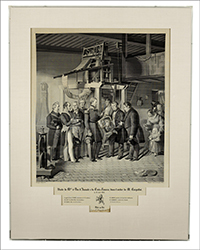
This book represents the most famous accomplishment in the life of its author, Jean-Baptiste Chappe d’Auteroche. He had observed the Transit of Venus (when Venus briefly passes between earth and the sun) from Siberia in 1761. In 1769, he was sent by France to observe the transit in 1769 from Baja California. By observing the transit of Venus, scientists are able to calculate the distance from Venus to Earth, and from that, the distance to the other planets. Getting this data would allow them to calculate the size of the solar system, unknown at the time. Obtaining the data from the 1769 transit was of compelling urgency. While the previous transit was separated by only eight years from this one, the cycles are such that after the eight year interval, the next transit would not occur for over another century. Chappe d’Auteroche had to hurry to Baja where the transit could be observed as he could not afford to be late. He required good weather for visibility at the right time. Fortunately, he was lucky with both. Unfortunately, his luck then quickly ran out. He contacted a disease spreading around the ship two days later and it killed him. His posthumous book, completed by others from his notes, is Voyage en Californie pour l’observation du passage de Vénus sur le disque du soleil le 3 juin 1769. It includes his description of the voyage to Baja. Item 23. 8,500 €.
Louis Pasteur is noted for his pasteurization process which made it possible to store milk without it quickly going bad. It is one of the most important advances ever in food safety. However, Pasteur also employed the process to protect something more dear to a Frenchman's heart - wine. Pasteur's book is Études sur le vin, ses maladies, causes qui les provoquent (studies on wine, its diseases, and the causes that provoke them). It was published by Pasteur in 1866. He determined that by heating wine in the bottle or barrel to 55-60 degrees C for 1-2 hours, it could be made safe for later consumption. Item 75. 800 €.
Clavreuil may be reached as follows:
London. Stéphane Clavreuil Rare Books, +44 798 325 2200 or stephane@clavreuil.co.uk.
Paris. Librairie Clavreuil, +33 (0)1 43 26 97 69 or basane@librairieclavreuil.com.
Their website is www.librairieclavreuil.com.