

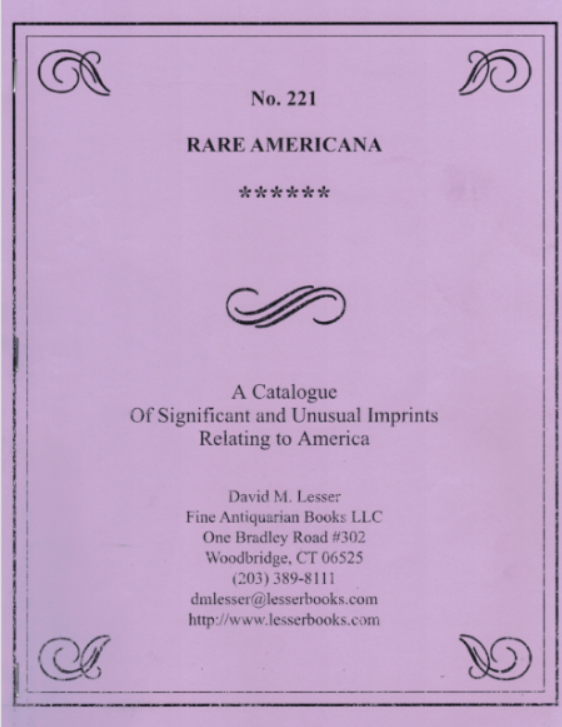
David M. Lesser Fine Antiquarian Books has released a new catalogue of Rare Americana. This is Catalogue 221. They have been publishing these for a long time, but the material itself goes back even farther than these catalogues. Much farther. Items mostly date from the 18th century to the early 20th. These are a few items you will find this time around.
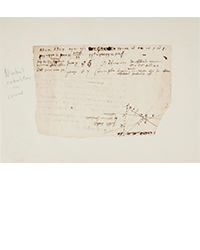
We begin with a one-page manuscript account of a harrowing escape by a pair of "backwoodsmen" on March 20, 1835. They were riding their horses quietly through Indian territory. At nightfall, they settled down by a stream, pulled out their salt pork and when finished they lay down in the grass to sleep. Around 2:00 in the morning, they heard a slight noise nearby. They were surrounded by Indians. They grabbed their rifles, jumped into their saddles, and headed for the area where they thought there were the fewest number of Indians. The guessed wrong. However, they kicked their spurs, fired their rifles, and passed the Indians, continuing their run with the Indians in pursuit. We don't know the eventual outcome, who the woodsmen were, or whether the story is true. Presumably, they survived if this happened as no one else could have told the story. In another hand on the back of the manuscript, it is signed "William H. Rigg." We don't know if he was one of the backwoodsmen or his connection to the story. Item 56. Priced at $750.
The South does not have a history of being very welcoming to black people. Item 23 is Reports of the Special Committee on the Governor's Messages, Transmitting Communications of the British Consul, published in 1852. South Carolina had passed a law preventing free Negroes from entering the state. As a result, when British ships docked at Charleston, the black seamen would be imprisoned "until the vessels in which they came are ready to depart." This was the time of Nat Turner's Rebellion and the white South Carolinians were afraid that free black seamen would encourage the slaves to revolt. The British protested but to no avail. South Carolina responded that it was "inexpedient" to change their laws. They did not want "access to our slaves" by "colored crews, many of which have been probably, but recently emancipated." Item 23. $750.
Blacks have been the major target of discrimination and worse in American history, but they are not alone. Item 64 is the Principles and Objects of the American Party, published in 1855. That was the peak of this party's significant, but short-lived life on the American stage. Their target was Catholics, particularly Irish Catholic immigrants during the mid-19th century. While officially the American Party, they became known as the "Know-Nothing" Party. That sobriquet was attached to their name because their members, when asked questions about the party, would respond by claiming they knew nothing. Their credo was "America should be governed only by Americans," immigrants not meeting their standard, though their members were also immigrants or the descendants of immigrants. The following year, they ran a former President, Millard Fillmore, as their presidential candidate and secured 22% of the vote, carrying Maryland, but James Buchanan won the election. After that, the nation became too involved in sectional differences to focus on Irish Catholics. The Know-Nothings themselves were divided by burning issues such as slavery. By 1860, the party was no more. Item 64. $275.
Many of the Know-Nothings came from the old Whig party, which itself disintegrated in the early 1850s. They elected two Presidents, William Henry Harrison and Zachary Taylor. In 1848, the party had a major decision when selecting a presidential candidate. They could choose Henry Clay, a major figure in American politics in the first half of the 19th century. He had made four attempts at the presidency before, always a serious candidate, but never a winner. He had been the Whig nominee in 1844, but lost a close election to James K. Polk. He was the favorite of many Whigs in 1848. However, the Whigs were more focused on winning the election, an area where Clay had a poor track record. They gravitated toward Zachary Taylor, a hero of the Mexican War with no discernible political opinions. However, they saw him as a winner, being a war hero. Item 13 is The Whole Whig Party of the United States, by John Minor Botts, published in 1848. He argued that Clay was the embodiment of Whig principles, while Taylor stood for nothing discernible. The Whigs chose to be practical. They nominated Taylor anyway who, as hoped, won the election. He only survived a little over a year in office, making the aforementioned Millard Fillmore President. Item 13. $250.
George Washington is such a great American leader, the recipient of great adulation both in his time and ours, that it is hard to face that he had his imperfections. In his own time, Edward Rushton was not unwilling to point them out. Item 101 consists of four issues of The American Universal Magazine from 1797. Printed in the June 13 issue is An Expostulatory Letter to George Washington, of Mount Vernon, in Virginia, on His Continuing to be a Proprietor of Slaves. The Declaration of Independence declared that, "all men are created equal, that they are endowed by their Creator with certain unalienable Rights, that among these are Life, Liberty and the pursuit of Happiness." In reality, that equality and those unalienable rights did not apply to people with darker skin. Rushton writes, "Shame! Shame! That man should be deemed the property of man or that the name of Washington should be found among the list of such proprietors...Ages to come will read with Astonishment that the man who was foremost to wrench the rights of America from the tyrannical grasp of Britain was among the last to relinquish his own oppressive hold of poor unoffending negroes." Rushton described slavery as "an idelible blot" on American liberty. It would be hard to argue against him. Washington did provide for the freeing of his slaves, but only after the death of himself and his wife. Martha did free them a little sooner, during her own lifetime, following George's death. Item 101. $5,000.
David M. Lesser Fine Antiquarian Books may be reached at 203-389-8111 or dmlesser@lesserbooks.com. Their website is www.lesserbooks.com.