




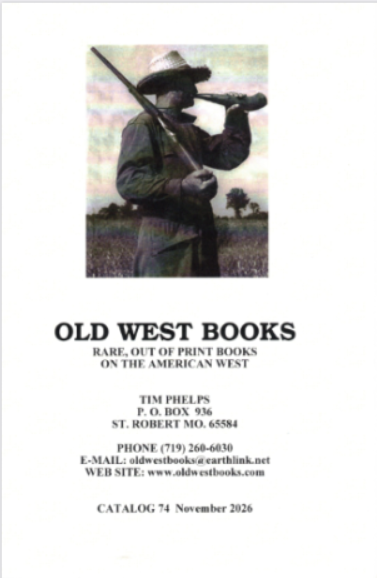
If you are interested in books from the Old West, then there couldn't be a more logical dealer than Old West Books. Their name says it all. They specialize in "rare, out of print books on the American West." In their Catalogue 74 November 2026, you will find names you recognize, like poor George Armstrong Custer who is remembered for the worst day of his life. You will also find people not as well known but still significant, and you will read about places and events that reflect life as it was, rather than just the cliché "western" stories. The West didn't need exaggeration. It was a spectacular place without it. Here are a few books from the days when the West was still old.
Bill Longley was a western outlaw of some repute though never developing the reputation of a Jesse James. Longley would not have been pleased. While at first trying to evade responsibility for killings, he soon tried to use his terrible behavior as a ticket to fame. Wikipedia describes him as having a "ruthless nature, speed with a gun, quick temper, and unpredictable demeanor." Any kind of reputation is better than no reputation at all. He was known to have killed seven men, generally as a result of some sort of personal dispute rather than theft. Longley claimed many more, but they were freedmen, that is Black men in the post Civil War years. Perhaps he felt that racial prejudice would allow him to have a reputation as a killer without offending the general population too much. Whatever his thoughts, it didn't save him. He was captured in 1877, a decade after his first killing, and found himself not at the wrong end of a gun, but at the wrong end of a rope. Item 20 is Adventures of Bill Longley, by Henry C. Fuller, published in 1878, the year of his demise. His ending came in Giddings, a small town in Texas near his childhood home. Item 20. Priced at $155.
S.M. Swenson was a Swedish immigrant who like Longley made his fortune in Texas. Actually, Longley didn't accumulate a fortune, but Svenson did, and he did it without breaking the law. He was a merchant selling supplies. He used his profits to buy land, vast amounts of it in Texas. His SMS ranches grew to be one of the largest landholders in Texas, several hundred thousand acres. He used the land to raise cattle. He leased much of the land to his sons who ran the cattle business. Swenson founded a bank in New York, but remained active in Texas. At the time of the Civil War, he remained loyal to the Union, risky behavior in Texas, but his connections allowed him to lay low. When even that was not enough to be secure, he sat out the rest of the war In Mexico. After the war, he moved to New York where he lived the remainder of his life, while staying closely connected to his Texas operations. Item 2 is Hypenated or The Life Story of S. M. Swanson, published in 1916. $4,750.
This is a stapled and string-tied history of the "Bottom" area of the Snake River in Idaho. The town site was known as American Falls. You won't be able to visit American Falls today unless you are a scuba diver. In the 1920s, the government authorized construction of a large dam. Some 344 homes, 46 businesses, three hotels and other structures were moved uphill on rollers or in carts. Then, the area was flooded. What was left, notably a large grain elevator, disappeared under the newly formed reservoir. Item 55 is Drowned Memories, by Minerva Kohlhepp Teichert, published in 1926, the year the dam was completed. This work is a tribute to the community and families that once lived in American Falls. It describes the cattle industry and ranching that once took place on the land and a history of the Indians and early explorers who preceded them. This will have to preserve the memory of the original American Falls as it is unlikely that anyone who ever lived in historic American Falls is alive today $750.
The American natives did not have many advocates among the western white settlers of the 19th century, but A. B. Meacham was an exception. He was appointed Superintendent of Indian Affairs for Oregon from 1869-1872. He had to deal with issues between the Modoc and Klamath on the Klamath Reservation. He brought Chief Joseph to Washington to speak to officials there. A Methodist minister and reformer, he fought to uphold Indian rights. It was a lonely and virtually unwinnable argument in his day. His book is Wigwam and War-Path or the Royal Chief in Chains. It is an account of the Modoc War, where a small number of Modoc warriors held off much larger forces for half a year before being forced from their homeland. They were exiled to Oklahoma. Item 36. $875.
Next is The History of Houston County Texas Together with Biographical Sketches of Many Pioneers and Later Citizens of Said County, Who have Made Notable Contributions to its Development and Progress. The author of this 1943 book is Armistead Albert Aldrich. You may think this is about a very large county, but actually is quite a small one. The city of Houston has 2.3 million residents and is the fourth largest city in the country, but the city of Houston is located in Harris County, not Houston County. Houston County has only 22,000 residents and its county seat, Crockett, is named after a different Texas hero, Davy Crockett. The two were about the same size in 1850, but the city has done much more growing ever since. This book will tell you about the county's history, pioneers, and Indian raids. Item 1. $450.
Old West Books may be reached at 719-260-6030 or oldwestbooks@earthlink.net. Their website is www.oldwestbooks.com.